To master top, middle, and base notes in just 7 days, start by understanding each layer’s role and aroma characteristics. Practice smelling samples regularly to sharpen your scent recognition and associate notes with memories or images. Experiment with blending simple ingredients, paying attention to how notes evolve over time. Keep notes of your adjustments and analyze the progress. If you keep exploring, you’ll develop a deeper sense of scent layers and composition techniques that take your skills further.
Key Takeaways
- Study the distinct roles and development timeline of top, middle, and base notes in fragrances.
- Practice smelling and identifying notes in samples to enhance scent recognition and memory.
- Experiment with blending techniques to understand how notes interact and evolve over time.
- Analyze existing perfumes to deconstruct their layered structures and note transitions.
- Keep detailed records of your formulations and progress to refine your skills systematically.
Understanding the Role of Top, Middle, and Base Notes in Fragrance Composition

Understanding the role of top, middle, and base notes is essential to grasp how a fragrance unfolds over time. The note hierarchy determines the scent progression you experience from first spray to dry-down. Top notes are what you smell immediately—they’re light, fresh, and fleeting. As the initial scent fades, middle notes emerge, forming the heart of the fragrance with more depth and complexity. Finally, the base notes develop slowly, lingering longest and anchoring the scent with richness and warmth. Recognizing this scent progression helps you appreciate a perfume’s structure and evolution. The different fragrance layers work together to create a harmonious and memorable scent experience. By understanding how each note plays its part in the hierarchy, you can better select fragrances that match your preferences and learn to anticipate how they will transform throughout the day.
Familiarizing Yourself With Common Fragrance Ingredients and Their Characteristics
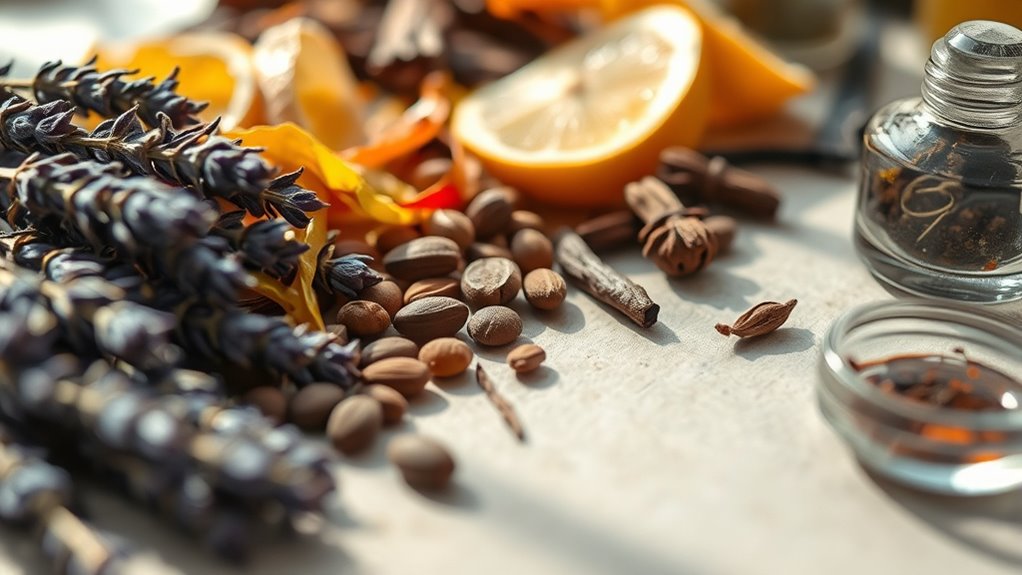
Getting familiar with common fragrance ingredients is essential to appreciating how perfumes are crafted and how they develop on your skin. Essential oils form the core of many fragrances, offering natural scents that define specific aroma profiles. Understanding different fragrance families—such as floral, citrus, woody, and oriental—helps you recognize the characteristics of ingredients within each group. For example, citrus oils are fresh and zesty, while woody oils like cedar or sandalwood provide warmth and depth. By learning these ingredients and their traits, you’ll better understand how top, middle, and base notes interact and evolve over time. Knowledge of seed allergy risks can also inform your awareness of potential sensitivities to natural ingredients used in fragrances. This knowledge allows you to identify what appeals to you and guides your exploration of perfumes with confidence.
Developing Your Sense of Smell: Exercises to Enhance Olfactory Perception

Enhancing your sense of smell requires deliberate practice, much like training any other skill. To improve your olfactory perception, focus on exercises that boost aroma memory and scent association. Start by smelling familiar scents and consciously recalling their characteristics. Practice identifying subtle differences between similar aromas to sharpen your perception. Use the table below to understand how these exercises build your olfactory skills:
| Exercise | Purpose | Benefit |
|---|---|---|
| Aroma memory drills | Strengthen recall of scents | Better scent recognition |
| Scent association | Link aromas to memories or concepts | Deeper scent understanding |
| Blind smelling | Identify aromas without cues | Enhance perception accuracy |
Consistent practice refines your nose, making it easier to distinguish and remember top middle base notes. Sound healing techniques can also be incorporated to promote relaxation and mental clarity, further enhancing your sensory awareness.
Experimenting With Basic Blending Techniques and Formulation Skills

You can start experimenting with different blending method variations to see how they influence your fragrance. Try combining ingredients in unique ways and adjust proportions to refine your formulation skills. These strategies will help you develop a more nuanced understanding of how base notes interact and evolve. Additionally, understanding drivetrain components and their wear can inform how you select and blend ingredients for longer-lasting fragrances.
Blending Method Variations
Experimenting with basic blending techniques can dramatically improve your ability to create balanced and nuanced middle base notes. Variations in blending methods—like layering or sequential addition—allow you to explore different textures and complexities. You might experiment with synthetic vs natural ingredients to see how they interact over time. Understanding fragrance aging processes helps you predict how your blend will evolve, ensuring a harmonious scent. Incorporating vintage decor elements into your process can inspire a more authentic and timeless approach to blending.
Key points to consider:
- Adjust blending order to influence scent development
- Use small batches to test different ingredient combinations
- Track how aging affects the balance of your middle notes
Formulation Experimentation Strategies
Mastering formulation experimentation involves systematically testing and refining your blending techniques to achieve desired scent profiles. To improve your skills, focus on scent layering—combining different notes to create depth and complexity. Experiment with small batches, adjusting proportions to enhance fragrance longevity and avoid overpowering scents. Keep detailed notes on each blend, noting how changes impact scent harmony and durability. Incorporate basic blending techniques like gradual addition and dilution to fine-tune your formulation. Don’t be afraid to try unconventional combinations; sometimes, unexpected pairings yield the best results. Remember, consistent testing helps you understand how each ingredient interacts, leading to more refined formulas. Additionally, exploring aroma interactions can help you better predict how different components will work together, ultimately leading to more successful blends. With practice, you’ll develop a keen sense for balancing components and optimizing your fragrances’ lasting power.
Analyzing and Replicating Popular Perfume Compositions

To replicate popular perfumes, start by identifying their signature notes and understanding how these elements interact. Break down the fragrance into layers to see how the middle and base notes support the overall scent. By studying these techniques, you can mimic composition styles and craft your own balanced creations.
Identifying Signature Notes
Understanding signature notes is essential when analyzing and replicating popular perfume compositions. These notes form the core of a scent’s identity and often evoke a strong scent memory. To identify a note signature, pay attention to how certain aromas persist or stand out throughout wear. Recognizing these key elements helps you grasp the perfume’s structure and replicate its essence. A good understanding of vetted products can also assist in selecting the most effective ingredients for your creations.
- Focus on what remains prominent from the top to the middle layers
- Notice which notes evoke a personal scent memory
- Observe how the signature note influences the overall character of the fragrance
Deconstructing Fragrance Layers
Deconstructing fragrance layers involves carefully analyzing how each note interacts and evolves over time. You need to observe the layer development, noting how the top notes fade, revealing the heart, and eventually giving way to the base notes. Pay attention to scent progression, understanding which notes dominate at different stages and how they blend seamlessly. This process helps you recognize the structure of a popular perfume and understand its composition. By dissecting these layers, you learn how fragrances maintain balance and complexity. Practice by smelling samples and tracking how the scent shifts over minutes or hours. This skill is essential for replicating compositions accurately and gaining insight into the art of perfume creation. Inspirational quotes about fatherhood can motivate you to appreciate the artistry involved in crafting layered fragrances and understanding their emotional impact.
Emulating Composition Techniques
Analyzing and replicating popular perfume compositions requires a keen ear for detail and a systematic approach. To do this effectively, focus on understanding the scent memory and fragrance symbolism behind each fragrance. By dissecting how top, middle, and base notes interact, you can emulate signature scents more accurately. Pay attention to the balance, intensity, and progression of notes, which reveal the emotional storytelling of the perfume. Consider these key points:
- Break down the fragrance’s structure to grasp its core themes.
- Identify dominant notes that define its character.
- Study how the notes evolve over time to replicate the scent’s journey.
- Recognizing the symbolic meanings behind certain notes can deepen your understanding of their roles in a composition.
This method sharpens your ability to recreate complex compositions and deepens your appreciation for fragrance storytelling. It’s a fundamental step toward mastering top middle base notes in your perfume journey.
Refining Your Creations: Adjusting and Balancing Notes for Harmony

To achieve a harmonious balance in your musical creations, you need to fine-tune your notes meticulously. Focus on note balancing, ensuring each element complements the others without overpowering. Listen carefully to how the middle and base notes interact, and make adjustments to create a seamless progression. Harmony adjustment is key; subtly shift the volume, tone, or duration of specific notes to enhance cohesion. Trust your ear and be patient—small tweaks can considerably improve the overall feel. Remember, perfect harmony isn’t about uniformity but about finding the right balance that resonates naturally. Regularly revisit your composition, making deliberate adjustments until every note supports the intended mood and depth. For retail-related services, knowing the hours today can help plan your editing sessions more effectively. This process elevates your work from good to professional quality.
Creating a Signature Blend and Continuing Your Perfume Journey
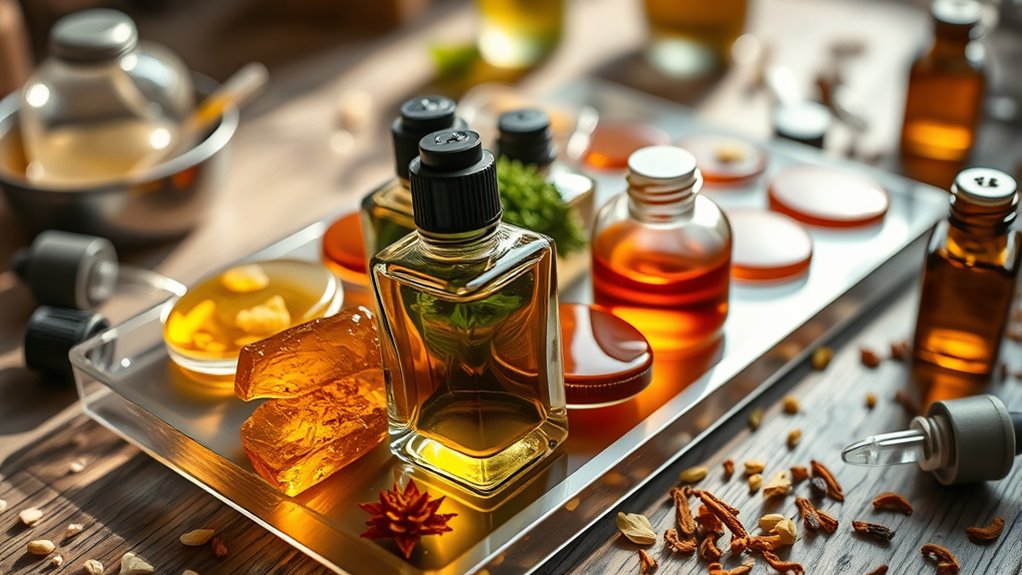
Creating a signature blend is your chance to express your unique scent identity, and it begins with understanding how different notes interact and complement each other. To refine your creation, experiment with scent layering to build depth and complexity. Remember, packaging aesthetics play a essential role in how your perfume is perceived—an attractive bottle enhances its appeal. As you continue your perfume journey, consider these tips:
- Mix complementary notes to craft a balanced, memorable scent
- Keep detailed records of your blends to replicate and refine later
- Explore different packaging styles to reflect your personal brand
Staying curious and attentive helps you develop an authentic signature scent. Your ongoing exploration keeps your fragrance journey fresh, exciting, and uniquely yours.
Frequently Asked Questions
How Long Does It Typically Take to Master Middle Base Notes?
It typically takes a few weeks to master middle and base notes when learning fragrance layering and choosing the right fragrance oils. You’ll want to experiment with different combinations, paying attention to how scents evolve over time. Practice regularly, and you’ll develop an intuitive sense of how to balance and enhance each layer. With patience and consistent effort, you’ll become confident in creating harmonious, long-lasting fragrances.
What Are the Most Versatile Middle Base Notes for Beginners?
You’ll find vanilla, sandalwood, and cedarwood to be the most versatile middle base notes for beginners. These notes blend easily with other scents, making blending techniques and scent layering simple. Start by experimenting with small amounts, mixing these bases with fresh florals or citrus to create unique combinations. Their warmth and depth help you develop your scent palette quickly, boosting your confidence as you master middle base notes.
Can Synthetic Ingredients Replace Natural Middle Base Notes Effectively?
Sure, synthetic ingredients can replace natural middle and base notes, but don’t expect them to match fragrance longevity or complexity. Synthetic vs natural debates often overlook how synthetic notes can be overly perfect, lacking that authentic charm. If you crave genuine depth and evolving scent, natural ingredients still reign supreme. While synthetics might boost longevity, they risk making your fragrance feel less nuanced—so choose wisely, or you’ll end up with a scent that’s solid but soulless.
How Do Seasonal Changes Affect the Perception of Middle Base Notes?
Seasonal fragrance shifts considerably influence how you perceive middle base notes. As temperatures rise or fall, the scent’s intensity and projection change, impacting your overall experience. Warmer weather can make base notes more prominent and vibrant, while cooler temperatures tend to soften them. You’ll notice that temperature impact on scent alters your perception, encouraging you to select fragrances that adapt well to seasonal changes for a balanced and pleasing aroma year-round.
Are There Specific Storage Methods to Preserve Fragrance Notes Better?
To protect your fragrance notes, you should store your scents properly. Keep your scent storage in a cool, dark place away from sunlight, heat, and humidity. Use airtight bottles to prevent evaporation and oxidation, which can affect fragrance preservation. Avoid frequent opening and keep bottles upright to minimize exposure to air. Proper storage ensures your perfumes maintain their original scent, longevity, and quality over time.
Conclusion
By mastering top, middle, and base notes in just a week, you reveal the secret to creating enthralling fragrances. Some say that understanding these layers is instinctual, but research suggests that with practice, anyone can develop a keen olfactory sense. Keep experimenting and refining your skills—your signature scent is within reach. Trust the process, and you’ll find that scent mastery isn’t just a talent, but a skill anyone can cultivate with dedication.