
TL;DR

Get the little things that make your day delivered free with Prime
- Fast, free delivery on millions of items
- Prime Video, Amazon Music and more included
- Member-only deals all year
Motivational quote wall art is decorative print or framed typography featuring inspirational quotes, and it’s one of the most affordable ways to personalize a space — printable downloads cost $3–$15 while framed pieces run $25–$100+. The best results come from short quotes (3–8 words), room-appropriate fonts and colors, and intentional placement where you’ll actually see the words daily.
The most-viewed wall in your home is probably the one you stare at during video calls. For millions of remote workers since 2020, that blank stretch of drywall behind the desk has become a design problem — and motivational quote wall art became its fastest, cheapest solution.
A $6 printable download, printed at a local shop and dropped into a $12 frame, can outperform a $200 canvas if you choose the right words, size, and spot. That’s the promise. The catch is that most quote walls fail for predictable reasons: quotes that are too long, fonts that fight the room, prints hung at the wrong height.
In this guide, you’ll learn exactly how to pick quotes that stick, match fonts and colors to your room’s style, size prints correctly the first time, and arrange a gallery wall that doesn’t look like a discount bookstore. You’ll also get the real price breakdowns and the free tools to make your own.
The best-selling quote prints run 3–8 words — if it can’t be read in one second from across the room, cut it.
Printable downloads ($3–$15) beat pre-framed art ($25–$100+) on cost and flexibility; buy standard sizes like 8×10, 11×14, and 16×20 so off-the-shelf frames fi…
Match typography to the room: thin sans-serifs for minimalist spaces, serifs for modern farmhouse, heavy block caps for gyms.
Hang art with its center at 57–60 inches from the floor, and place quotes at daily decision points — your exit door, above your monitor, opposite the toilet.
Short quotes generally aren’t copyrightable, but fonts and longer passages are — use commercially licensed fonts if you plan to sell your designs.
Why Motivational Quote Wall Art Actually Works (and When It Doesn’t)
Motivational quote wall art works through repetition, not magic. A phrase you read twenty times a day quietly becomes a default thought — which is why the same poster that feels cheesy in a store can feel personal on your own wall. Psychologists call this priming; your environment keeps feeding your brain the same message until it sticks.
But it fails fast when the quote means nothing to you. A generic “Live Laugh Love” above the toilet is decoration. A line from the speech your coach gave before your first marathon, printed and hung above your treadmill, is fuel.
Consider a real scenario: a nurse working night shifts hangs “You didn’t come this far to only come this far” by her front door. She sees it every time she leaves at 6 p.m. in the dark. That placement works because the message meets the moment. The same quote above a guest bathroom sink does nothing.
If you’d be embarrassed to explain to a friend why a quote matters to you, it’s the wrong quote for your wall.
That’s the honest test. Motivation is personal — skip the guilt if a popular phrase does nothing for you, and skip the cynicism if a simple one does.
How to Pick a Quote People Won’t Stop Reading: The 3–8 Word Rule
The best quote wall art is short — 3 to 8 words is the sweet spot for best-sellers on Etsy and Society6. Anything longer becomes unreadable from across the room, and unreadable art is just texture.
Long quotes fail for a physical reason: your eyes can parse about 4–6 words at a glance at typical viewing distance. “Do it now” lands instantly. A 30-word Maya Angelou passage requires you to stand and read — so after week one, you stop.
- Fitness walls: “One more rep,” “Sweat is just fat crying,” “Earn the shower”
- Home offices: “Done is better than perfect,” “Focus,” “Make it happen”
- Kids’ rooms: “Be brave,” “You are loved,” “Dream big”
- Classrooms: “Mistakes mean you’re trying,” “Kind is cool”
- Faith-based spaces: short scripture references and single-line verses dominate this niche
Notice the pattern. Every phrase works at a glance, from six feet away, in bad lighting. When you draft your own quote, apply the doorframe test: could someone walking past read it in one second? If not, cut words until they can.
Popular categories reflect what people are working toward: fitness, entrepreneurship, family, faith, and mental health dominate sales. Pick the category that matches the room’s actual purpose — hustle quotes in a bedroom tend to work against rest.
Printable Download vs. Pre-Framed Art: What Your Money Actually Buys
Printable downloads are the best value in quote wall art: they cost $3–$15, you receive them instantly, and you can print them at any size, forever. Pre-framed pieces run $25–$100+ and make sense when you want gallery-quality framing without the errands.
Here’s the honest comparison:
| Factor | Printable Download | Pre-Framed Art |
|---|---|---|
| Typical cost | $3–$15 per design | $25–$100+ per piece |
| Delivery | Instant, via email | 3–10 days shipping |
| Size flexibility | Reprint at any size | Fixed at purchase |
| Framing | You source the frame | Included, ready to hang |
| Best for | Gallery walls, budget makeovers, renters | Statement pieces, gifts, time-poor buyers |
| Hidden cost | Printing ($2–$10 at a print shop) | Shipping damage risk |
Do the math on a three-piece gallery wall: three downloads at $12 total, printed for $6 each at a local shop, in three $12 IKEA frames — about $78 all-in. The equivalent pre-framed set often runs $150–$250.
One tip sellers won’t tell you: buy downloads in standard sizes (8×10, 11×14, 16×20) so off-the-shelf frames fit without custom cutting. A4 and A3 sizes work if you’re outside the US.
Match the Font and Color to Your Room in 60 Seconds
Your room’s style should dictate the typography, not the other way around. The current market has moved decisively toward minimalist typography — clean sans-serifs and neutral palettes like beige, terracotta, and sage — while bold serif fonts ride the “quiet luxury” and modern farmhouse trends.
Think of it this way: the font is the outfit, the quote is the person. A gritty gym slogan in delicate script feels like a contradiction; a soft nursery rhyme in heavy industrial type feels harsh.
| Room Style | Font That Works | Palette |
|---|---|---|
| Minimalist / modern | Thin sans-serif | Black on white, one accent |
| Modern farmhouse | Serif or ledger-style | Cream, sage, terracotta |
| Industrial / loft | Bold condensed caps | Black, charcoal, metallic |
| Boho | Mixed serif + script | Warm earth tones |
| Gym / garage | Heavy block caps | High contrast, red or white |
A concrete example: a sage-green reading nook with linen curtains calls for a serif quote in cream on beige. Drop the same quote in neon script on black and the corner stops feeling calm. The words matter less than whether the piece belongs in the room.
How to Arrange a Quote Gallery Wall That Looks Designer-Done
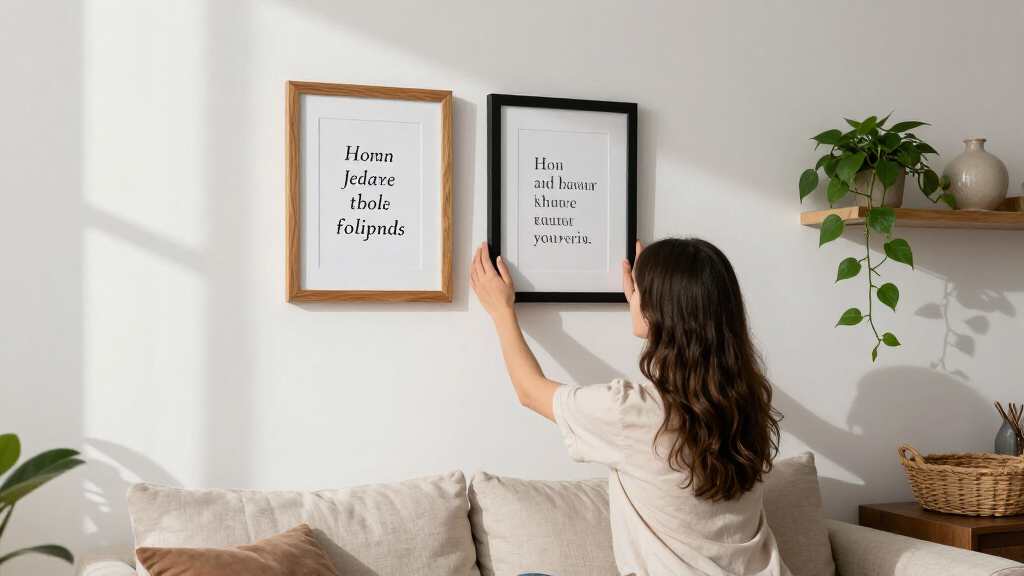
A great quote gallery wall follows one rule: odd numbers, varied sizes, one anchor piece. Start with your largest print in the center at 57–60 inches from floor to center — the standard museum hanging height most people ignore.
Then work outward in five steps:
- Pick your anchor: one 16×20 print with your most important quote.
- Flank it with two smaller 8x10s, keeping 2–3 inches between frames.
- Vary orientation: mix portrait and landscape frames so the grid doesn’t look like a spreadsheet.
- Limit to 3–5 words per quote — longer pieces become the visual noise of the wall.
- Mock it up first: trace frames on kraft paper, tape the paper to the wall, and adjust before hammering a single nail.
The kraft-paper step takes ten minutes and saves your drywall. A designer in Austin I read about calls it “free regret insurance” — you’ll move things three times on paper for every one hole you’d have made in the wall.
One common mistake: hanging art too high. If the center of your arrangement sits above eye level (about 57–60 inches), guests will feel like they’re reading a ceiling. Lower beats higher, almost always.
Where to Hang It So You Actually See It: Placement by Room
Placement determines whether your quote wall art motivates or disappears. Hang motivational prints at the decision points in your day — the door you leave through, the wall you face while working, the mirror you check before a workout.
Remote work changed this market for good. Since 2020, home-office quote art has been one of the fastest-growing decor niches, because the background of your video call is now a room other people see.
- Front door exit path: the last thing you read before leaving — best for “you’ve got this” energy
- Directly above your monitor: for focus mantras, not long quotes
- Above the treadmill or weight rack: high contrast, visible mid-workout when you’re squinting
- Opposite the toilet: genuinely prime real estate; you look at that wall every day
- Kitchen entryway: family and gratitude quotes perform best here
My favorite real-world example: a teacher who hung “Mistakes mean you’re trying” not in her classroom, but above her own desk where only she could see it. The audience for motivational art is usually you, not your guests — place it accordingly.
Make Your Own Quote Print for Free: 4 Tools Ranked by Ease
You can create professional-looking quote art in under 30 minutes with free tools — no design skills required. Canva is the best starting point for most people because its free tier includes hundreds of typography templates sized for standard frames.
- Canva (free): search “quote poster,” swap the text, export as PDF for crisp printing. Best all-rounder.
- Figma (free): more control over kerning and layout if you’re comfortable with a slight learning curve.
- Google Fonts + Google Docs: the cheapest possible route — pick a free font like Playfair Display, set a big text box, export as PDF.
- AI design tools: increasingly used to generate unique typography layouts, though check that fonts are commercially licensed if you plan to sell.
A quick copyright reality check: short quotes are generally not copyrightable, which is why the same phrases appear across thousands of Etsy shops. What is protected: specific designs, font licenses, and longer passages. If you’re making art for your own wall, don’t worry. If you’re selling, use fonts with commercial licenses and skip song lyrics and long book excerpts.
Export at 300 DPI in your frame’s exact size. A 16×20 print at 300 DPI is a 4800 x 6000 pixel file — most print shops will handle this fine, but phone screenshots won’t.
Frequently Asked Questions
What size should I print motivational quote wall art?
For a single statement piece, print at 16×20 or 18×24 inches. For gallery walls or smaller spaces, 8×10 and 11×14 work best because standard frames are cheap and widely available. If you’re outside the US, A4 and A3 sizes fit common frames. Always export or order at 300 DPI so the typography stays crisp up close.
Are printable quote downloads worth it compared to framed art?
Yes, for most people. A download costs $3–$15, prints for $2–$10 at a local shop, and you can reprint at any size forever — a full gallery wall can come in under $80. Pre-framed pieces ($25–$100+) are worth it only when you want one polished statement piece or a no-effort gift.
Can I legally sell quote wall art on Etsy?
Short quotes are generally not copyrightable, which is why common phrases appear across thousands of shops. However, specific designs, font licenses, song lyrics, and long passages from books or speeches may be protected. Use fonts with commercial licenses, avoid lyrics and extended excerpts, and check trademark databases for slogans tied to brands.
What are the best quotes for a home office or gym?
For home offices, short focus phrases win: “Done is better than perfect,” “Focus,” and “Make it happen.” For gyms, go high-contrast and punchy: “One more rep,” “Earn the shower,” or “You didn’t come this far to only come this far.” Keep everything to 3–8 words so it stays readable mid-task or mid-set.
Where can I buy quality motivational quote prints?
The biggest marketplaces are Etsy (best for instant downloads and personalization), Amazon (fast framed options), and Society6, Redbubble, and Desenio (curated artist designs). Pinterest isn’t a shop, but it’s the best place to browse styles and find specific sellers before buying.
Conclusion
Here’s the one thing to remember: motivational quote wall art only works if you’d actually say the words out loud. Pick a phrase that means something to you, keep it under eight words, match the font to the room, and hang it where your eyes land every single day. A $6 download, done right, beats an expensive canvas done wrong.
So look at the blank wall you see most often — the one behind your desk, or beside your front door. What’s the one sentence you’d want it to say to you tomorrow morning? That’s your print. Everything else is just framing.
Popular right now

Shark Navigator Robot Vacuum with Self-Empty Base, Dark Grey (RV2120AE)

Ninja Foodi Air Fryer 10 Qt DualZone 6-in-1 Black DZ302

Ninja Foodi DZ201 8-Quart DualZone 6-in-1 Air Fryer
As an affiliate, we earn on qualifying purchases.