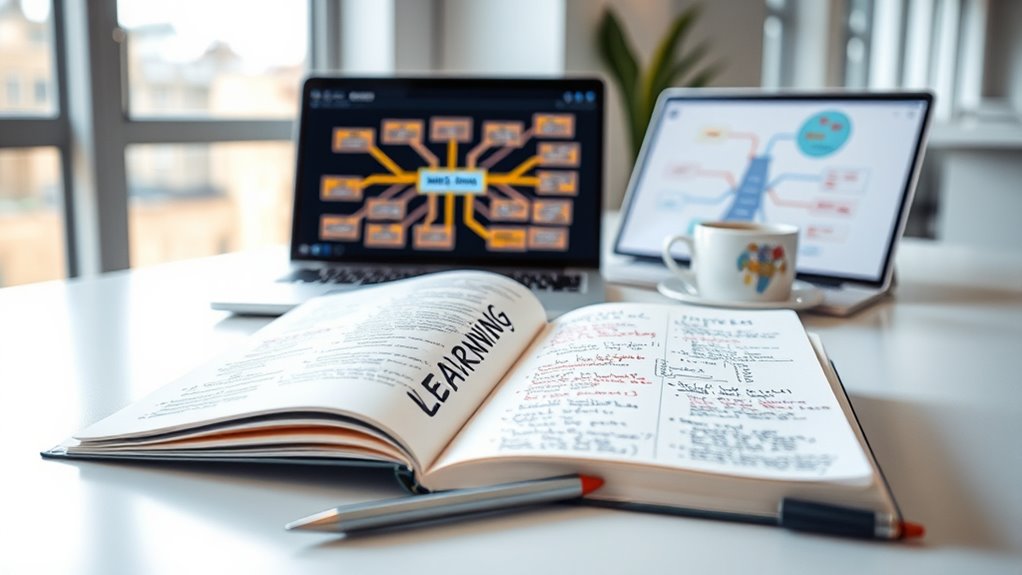

To learn faster, focus on meta-learning by understanding effective strategies like spaced repetition, retrieval practice, and chunking. Develop your cognitive flexibility by trying different approaches and adjusting when something doesn’t work. Stay aware of your habits and challenge ineffective methods to improve. Combining these techniques creates an adaptable learning toolkit that boosts retention and mastery. Keep exploring, and you’ll discover even more ways to accelerate your growth.
Key Takeaways
- Use active learning techniques like retrieval practice and spaced repetition to enhance retention.
- Cultivate cognitive flexibility by experimenting with different strategies and adjusting as needed.
- Break complex topics into smaller parts and create analogies for better comprehension.
- Develop awareness of your learning habits to identify and improve ineffective strategies.
- Maintain an adaptable mindset, viewing challenges as opportunities for growth and skill mastery.

Ever wondered how some people pick up new skills faster than others? The secret often lies in their approach to learning, specifically their use of effective learning strategies and their cognitive flexibility. When you understand and apply these concepts, you can accelerate your learning process considerably. Learning strategies are methods or techniques that help you absorb, retain, and apply new information more efficiently. Instead of passively reading or watching, you actively engage with the material through techniques like spaced repetition, retrieval practice, or chunking. These strategies make your study sessions more productive and help solidify your understanding. But equally important is cognitive flexibility—the ability to adapt your thinking and switch between different approaches or perspectives. This mental agility allows you to overcome obstacles, see problems from various angles, and adjust your learning methods when something isn’t working.
When you incorporate learning strategies into your routine, you’re essentially creating a toolkit that adapts to different types of material and challenges. For example, if you’re learning a language, you might switch between flashcards, conversation practice, and listening exercises to keep the process fresh and effective. Cognitive flexibility enhances this by encouraging you to experiment with different strategies based on what’s most effective in each situation. If you find that a particular method isn’t helping you grasp a concept, instead of sticking stubbornly to it, you pivot and try another approach. This mindset reduces frustration and keeps your motivation high. It also fosters a growth-oriented attitude—seeing mistakes and setbacks as opportunities to learn rather than failures. Developing emotional alignment can further support your learning journey by helping you stay motivated and focused on your goals.
To develop this flexibility, you need to become more aware of your learning habits and actively challenge them. Ask yourself what works and what doesn’t, and be willing to modify your strategies accordingly. For example, if you’re struggling with complex topics, breaking them into smaller parts or creating analogies can make understanding easier. By doing so, you’re exercising your cognitive flexibility, training your brain to adapt quickly to new information. Over time, this makes you more resilient and efficient in learning new skills. Remember, the key isn’t just about finding the right techniques but also about being adaptable and open-minded. Combining effective learning strategies with a flexible mindset empowers you to learn faster and more effectively, turning the process of acquiring knowledge into a dynamic, engaging experience.
Frequently Asked Questions
Can Meta-Learning Be Applied to Improve Emotional Intelligence?
Yes, you can apply meta-learning to improve emotional intelligence by focusing on emotional awareness and social skills. By actively reflecting on your emotional responses and identifying effective strategies, you learn how to better manage feelings and interact with others. Practicing this self-awareness and adapting your approach helps you develop stronger emotional intelligence over time. With consistent effort, meta-learning enables you to become more empathetic, responsive, and confident in social situations.
How Long Does It Typically Take to See Results From Meta-Learning?
You can usually see results from meta-learning within a few weeks, but it varies based on your learning timeline and goals. Expect consistent progress as you adapt strategies and reflect on your experiences. Don’t set unrealistic progress expectations; instead, focus on steady improvement. With dedication, you’ll notice better learning efficiency over time, and your ability to transfer skills will strengthen, making your learning process more effective.
Is Meta-Learning Effective for All Age Groups?
Think of meta-learning as a versatile tool that adapts like a chameleon to any environment. You’ll find it effective across all age groups because it considers age adaptability and learning styles, customizing techniques to fit your needs. Whether you’re young or older, meta-learning helps you optimize your approach, making it easier to absorb new information and develop skills faster, regardless of your stage in life.
What Are Common Pitfalls When Starting With Meta-Learning?
When starting with meta-learning, you might fall into learning misconceptions like overestimating immediate results or skipping foundational steps. Beginner errors include neglecting to set clear goals, not reflecting on your learning process, or trying to learn everything at once. To avoid these pitfalls, focus on gradual progress, stay patient, and regularly analyze what’s working or not. This way, you build effective, sustainable learning habits from the start.
How Does Meta-Learning Differ From Traditional Studying Methods?
Like Da Vinci seeking mastery, you approach meta-learning differently. It emphasizes understanding your study techniques and learning strategies, rather than just memorizing facts. Unlike traditional methods that focus on passive review, meta-learning encourages active reflection, adaptation, and self-awareness. You become your own coach, optimizing how you learn by discovering what works best. This shift transforms studying into a personalized journey, empowering you to learn faster and more effectively.
Conclusion
So, now you’re practically a meta‑learning guru—ready to conquer every skill with the speed of light. Just remember, all those hours of studying smarter mean nothing if you forget to enjoy the chaos of learning. But hey, who needs patience when you can master anything faster than your Wi-Fi loads a video? Embrace the irony: the more you “learn” to learn, the faster you’ll realize you still have a lifetime of stuff to forget. Happy speedy studying!