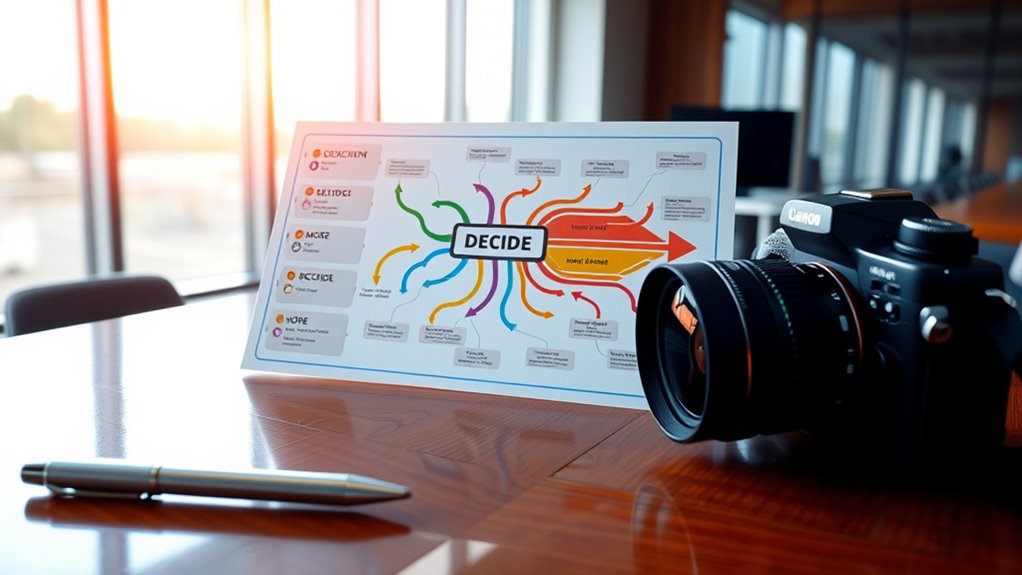

Decision-making models like OODA (Observe, Orient, Decide, Act) and DECIDE help you make faster, smarter choices by blending intuition with structure. OODA emphasizes rapid perception and adjustment in dynamic situations, while DECIDE guides you through analyzing problems and considering options efficiently. Both models leverage heuristics—mental shortcuts that simplify complex decisions. Mastering these approaches lets you respond confidently under pressure and refine your judgment; if you keep exploring, you’ll discover how to apply these tools effectively in real-world scenarios.

Get the little things that make your day delivered free with Prime
- Fast, free delivery on millions of items
- Prime Video, Amazon Music and more included
- Member-only deals all year
Key Takeaways
- OODA Loop emphasizes rapid observation, orientation, decision, and action for competitive, dynamic environments.
- DECIDE guides structured decision-making through problem definition, criteria, options, and evaluation, often leveraging heuristics.
- Both models integrate heuristic shortcuts to enable quick, effective judgments in complex or high-pressure situations.
- Awareness of biases and cognitive limits enhances the effectiveness of OODA and DECIDE in decision-making.
- Additional models and techniques focus on balancing intuitive heuristics with analytical processes for optimized decisions.

Have you ever wondered how people make complex decisions quickly and effectively? It often seems like they have a secret weapon—an ability to process information rapidly and act decisively. That’s where heuristic shortcuts come into play. These mental shortcuts allow you to simplify decision-making processes by relying on intuitive judgments, which are quick, automatic assessments based on past experiences and mental patterns. Instead of analyzing every detail, you instinctively zero in on the most relevant cues, enabling you to make decisions in moments that could otherwise take hours or days. This approach is especially useful in high-pressure situations where time is limited, and clarity is essential. Recognizing and trusting your intuitive judgments can help you navigate complex scenarios with confidence, but it’s also important to understand their limits and biases.
Heuristic shortcuts enable quick, intuitive decisions in high-pressure situations, but awareness of biases is essential for effective judgment.
When you look at decision-making models like the OODA loop—Observe, Orient, Decide, Act—you see a framework designed to streamline this process. The OODA loop emphasizes rapid observation and orientation, where heuristic shortcuts and intuitive judgments are *crucial*. By quickly gathering information and instinctively interpreting it through mental models, you can move swiftly to the decision and action stages. This model is particularly effective in competitive or dynamic environments, such as military operations or business negotiations, where staying ahead of your opponent or market is *vital*. The key is to trust your intuitive judgments but also stay aware of potential cognitive biases that might distort your perception or lead you astray.
Similarly, the DECIDE model guides you through a structured decision process, but it also leverages your natural inclinations for speed and efficiency. It encourages you to define the problem, establish criteria, consider alternatives, and evaluate options—all while relying on heuristics to filter and prioritize information. Your intuition helps you quickly discard less relevant options and focus on those most aligned with your goals. This balance between structured analysis and intuitive judgment allows you to make well-informed decisions without getting bogged down in unnecessary details. Over time, as you become more experienced with these models, your intuitive judgments become sharper, helping you to anticipate outcomes and respond more effectively.
Ultimately, understanding how heuristic shortcuts and intuitive judgments influence your decision-making empowers you to act with greater confidence and agility. Recognizing when to trust your instincts and when to slow down and analyze can be the difference between success and failure. Decision-making models like OODA and DECIDE serve as valuable tools to harness your natural cognitive tendencies, enabling you to make smarter choices faster—no matter how complex the situation.
Frequently Asked Questions
How Do Decision-Making Models Adapt to Rapidly Changing Environments?
You adapt decision-making models to rapidly changing environments by relying on heuristic shortcuts, which speed up your choices, and by being aware of cognitive biases that might skew your judgment. You prioritize flexibility, constantly updating your actions based on new information. This helps you stay responsive and effective, even under pressure. Recognizing these mental shortcuts and biases allows you to make quicker, more accurate decisions in dynamic situations.
What Are the Limitations of the OODA Loop in Complex Scenarios?
You might find the OODA loop limited in complex scenarios because heuristic pitfalls and cognitive biases can distort your perceptions and judgments. These mental shortcuts may cause you to misjudge threats or opportunities, leading to flawed decisions. Additionally, in fast-changing environments, the iterative process might lag, making it harder to adapt quickly. Recognizing these limitations helps you refine your approach and avoid common pitfalls that hinder ideal decision-making.
How Can These Models Be Integrated Into Team Decision Processes?
You can seamlessly synchronize team collaboration by integrating decision frameworks into your process. Use clear, consistent communication to cultivate cohesion, ensuring everyone understands their roles within the models. Foster flexibility by encouraging feedback and quick adjustments, which enhances the decision-making cycle. Incorporate structured stages from models like OODA and DECIDE to streamline strategies, supplement teamwork, and solidify shared success—making your team’s decisions more dynamic, decisive, and unified.
Are There Specific Industries Where One Model Outperforms Others?
Yes, sector-focused model effectiveness varies across industries. For example, the OODA loop excels in fast-paced sectors like aerospace or military, where quick adaptation is vital. Conversely, decision frameworks tailored to healthcare prioritize accuracy and thorough analysis, making models like DECIDE more effective. You’ll find that industry-specific decision frameworks help optimize outcomes by aligning decision-making approaches with sector demands. Choose the model that best fits your industry’s agility and complexity.
How Do Personal Biases Influence Decision-Making Models’ Effectiveness?
Your personal biases substantially impact decision-making models’ effectiveness by skewing your judgment through bias impact and cognitive distortions. These biases can cause you to overlook critical information or favor familiar options, leading to suboptimal choices. Recognizing these influences helps you actively counteract bias impact, ensuring you evaluate situations more objectively. Being aware of cognitive distortions allows you to refine your decision process, ultimately making better, more balanced decisions.
Conclusion
As you explore decision-making models like OODA and Decide, you realize they aren’t just theories—they’re tools that reveal how choices shape your world. Sometimes, a split second or unexpected event aligns perfectly, guiding your next move. Just like the quiet moments that seem insignificant, they often hold the key to clarity. Embrace these models, and you’ll find that even in chaos, your best decision might be just around the corner—waiting to be uncovered.
Products Worth Considering
As an affiliate, we earn on qualifying purchases.