
The best science kits for teenagers pair hands-on projects with enough challenge to hold a teen’s interest. My best overall pick is the ELEGOO UNO R3 Smart Robot Car Kit, which combines coding, electronics, and a working robot; the Thames & Kosmos Chem C1000 stands out for a more structured chemistry experience, while the Thames & Kosmos Bridges & Skyscrapers kit suits teens drawn to design and construction. The main tradeoff is between guided experiments that are easy to start and open-ended builds that offer more room to learn but may need patience or adult help. Other options focus on quick discoveries, such as geodes, or a particular topic like hydraulics and solar power. Read on for the full breakdown and advice on choosing a kit that fits the teen, not just the age label.

Get the little things that make your day delivered free with Prime
- Fast, free delivery on millions of items
- Prime Video, Amazon Music and more included
- Member-only deals all year
Key Takeaways
- The ELEGOO robot car is the strongest all-around choice for teens who want to combine a physical build with coding and electronics rather than complete a series of short demonstrations.
- The two Thames & Kosmos chemistry kits serve different needs: Chem C1000 is the more focused route into chemistry, while the Mega Science Lab spreads its activities across a wider range of topics.
- Mechanical kits teach different kinds of engineering. The HydroBot Arm and Mega Cyborg Hand emphasize hydraulic movement, while the Bridges & Skyscrapers kit centers on structural design and load-bearing.
- Solar robot kits trade depth for variety. Sillbird’s 12-in-1 format offers multiple builds, but teens seeking sustained coding or electronics practice may get more from the ELEGOO robot car.
- Several National Geographic kits lean toward accessible, short activities. Geodes, gross science, and science magic can be inviting starts, but their age ranges and activity styles may feel less challenging to older teens.
| ELEGOO UNO R3 Smart Robot Car Kit V4 with Camera |  | Best for Teen Coding and Robotics | Brand: ELEGOO | Model: US-EL-KIT-012 | Controller board: ELEGOO UNO R3 | VIEW ON AMAZON | See Our Full Breakdown |
| UNGLINGA 150-Experiment Science Kit for Kids | 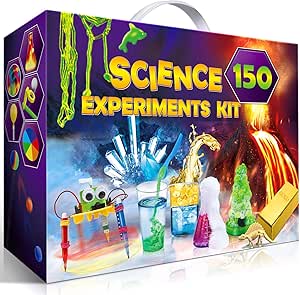 | Best for Broad Experiment Variety | Brand: UNGLINGA | Number of experiments: 150 | Recommended age: 8 years and up | VIEW ON AMAZON | See Our Full Breakdown |
| National Geographic Break Open 10 Premium Geodes Kit |  | Best for Hands-On Geology | Brand: Blue Marble | Model number: NGGEO10 | Recommended age: 8 years and up | VIEW ON AMAZON | See Our Full Breakdown |
| Smartivity Robotic Mechanical Hand STEM Toy for Kids Ages 8–14 |  | Best Screen-Free Build | Brand: Smartivity | Model: SMRT1135 | Recommended age: 8–14 years | VIEW ON AMAZON | See Our Full Breakdown |
| EUDAX Basic Electricity and Magnetism Experiment Kit |  | Best for Circuits and Electromagnetism | Brand: EUDAX | Model number: EUDAX-FC-80PCS | Number of items: 79 | VIEW ON AMAZON | See Our Full Breakdown |
| National Geographic Amazing Chemistry Set, 100+ Experiments, Ages 8+ |  | Best for Flexible Chemistry Exploration | Brand: Blue Marble | Age range: 8 years and up | Experiment count: 100+ (15 with included materials; 85 using household items) | VIEW ON AMAZON | See Our Full Breakdown |
| Thames & Kosmos Chem C1000 Beginner Chemistry Set |  | Best for Serious Beginner Chemists | Brand: Thames & Kosmos | Model: Chem C1000 (V 2.0) | Age range: 10+ | VIEW ON AMAZON | See Our Full Breakdown |
| Teach Tech HydroBot Arm Hydraulic STEM Building Kit for Ages 12+ |  | Best for Hydraulic Engineering | Brand: Teach Tech | Model: TTR-632 | Recommended age: 12 years and up | VIEW ON AMAZON | See Our Full Breakdown |
| Sillbird 12-in-1 Solar Robot Building Kit, 190 Pieces |  | Best for Renewable-Energy Variety | Brand: Sillbird | Model: US-SB-SolarRobot | Recommended age: 10 years and up | VIEW ON AMAZON | See Our Full Breakdown |
| ANNISOKA DIY Wooden Robot Arm Kit |  | Best for Circuits and Mechanics | Brand: ANNISOKA | Material: Wood | Age range: 8 years and up | VIEW ON AMAZON | See Our Full Breakdown |
| National Geographic Mega Science Lab with 75 Experiments for Kids |  | Best Variety for Curious Teens | Brand: Blue Marble | Age range: 8 years and up | Experiments: 75 total: materials for 45, plus 30 using household items | VIEW ON AMAZON | See Our Full Breakdown |
| Thames & Kosmos Structural Engineering: Bridges & Skyscrapers Science Kit |  | Best for Hands-On Engineering | Brand: Thames & Kosmos | Model count: 20 | Piece count: 285+ | VIEW ON AMAZON | See Our Full Breakdown |
| Thames & Kosmos Mega Cyborg Hand STEM Experiment Kit |  | Best Wearable Build | Brand: Thames & Kosmos | Model number: 620501 | Age range: 7 years and up | VIEW ON AMAZON | See Our Full Breakdown |
| National Geographic Gross Science Kit with 45 Experiments for Kids Ages 8–12 |  | Best for Gross-Out Chemistry | Brand: National Geographic | Recommended age: 8–12 | Experiments with supplied materials: 15 | VIEW ON AMAZON | See Our Full Breakdown |
| National Geographic Science Magic Kit for Kids |  | Best for Science-Minded Performers | Brand: Blue Marble | Age range: 8 years and up | Experiments with included materials: 20 | VIEW ON AMAZON | See Our Full Breakdown |
| science kits for teenager | Brand | Recommended age |
|---|---|---|
| ELEGOO UNO R3 Smart Robot Car | ELEGOO | 12 years and up |
| UNGLINGA 150-Experiment Scienc | UNGLINGA | 8 years and up |
| National Geographic Break Open | Blue Marble | 8 years and up |
| Smartivity Robotic Mechanical | Smartivity | 8–14 years |
| EUDAX Basic Electricity and Ma | EUDAX | 8–18 years |
| National Geographic Amazing Ch | Blue Marble | — |
| Thames & Kosmos Chem C1000 Beg | Thames & Kosmos | — |
| Teach Tech HydroBot Arm Hydrau | Teach Tech | 12 years and up |
| Sillbird 12-in-1 Solar Robot B | Sillbird | 10 years and up |
| ANNISOKA DIY Wooden Robot Arm | ANNISOKA | — |
| National Geographic Mega Scien | Blue Marble | — |
| Thames & Kosmos Structural Eng | Thames & Kosmos | — |
| Thames & Kosmos Mega Cyborg Ha | Thames & Kosmos | — |
| National Geographic Gross Scie | National Geographic | 8–12 |
| National Geographic Science Ma | Blue Marble | — |
More Details on Our Top Picks
ELEGOO UNO R3 Smart Robot Car Kit V4 with Camera
This is my pick for teenagers who want science to involve building, coding, and motion, rather than following a sequence of stand-alone experiments. The UNO R3 controller works with Arduino IDE, while the camera and Wi-Fi module add FPV video; line tracking and ultrasonic obstacle avoidance give teens clear ways to see their programs affect the car’s behavior. App and IR remote controls also let beginners start interacting before they tackle code. Compared with the EUDAX Basic Electricity and Magnetism Experiment Kit, this kit offers a more integrated robotics project but less direct practice with circuits and electromagnetism. Assembly and programming take time, and a first-time builder may need adult guidance. I’d choose it for a teen ready to work through a sustained project, not someone looking for quick, largely ready-to-run experiments.
Pros:- Combines Arduino programming with a physical robot project.
- FPV video, line tracking, and obstacle avoidance offer varied ways to explore robotics.
- App and IR remote control provide options for interacting with the car.
- Illustrated guidance and keyed connectors help make assembly more approachable.
Cons:- Assembly and programming require more time and persistence than ready-to-start experiment kits.
- First-time builders may need adult guidance to complete the build and work through coding.
Best for: Teenagers interested in Arduino, beginner programming, and building a robot with camera-based control features.
Not ideal for: Teens who want short experiments with minimal setup, or first-time builders without adult help available.
- Brand:ELEGOO
- Model:US-EL-KIT-012
- Controller board:ELEGOO UNO R3
- Camera and Wi-Fi module:ESP32-WROVER-based
- Battery:2000 mAh rechargeable lithium-ion
- Sensors:Line-tracking and ultrasonic
- Control methods:App and IR remote
- Recommended age:12 years and up
- Dimensions:8 × 7 × 6 inches
Our verdict“Choose this for a teenager ready to build and program a feature-rich robot, rather than a kit focused on quick experiments.”
UNGLINGA 150-Experiment Science Kit for Kids
The UNGLINGA kit makes the most sense for families who want a wide menu of activities across chemistry, physics, and earth science, rather than a single extended build. Its 150 experiments and illustrated, step-by-step manual give teens options to follow their curiosity and choose activities at different times. Compared with the National Geographic Break Open 10 Premium Geodes Kit, it covers more kinds of science, while the geode kit offers a more focused experience with natural specimens to examine. The tradeoff is that a large experiment count does not mean every activity is ready to start from the box: some call for common household items that are not included. Its stated age range begins at eight, so older teens seeking deeper coding or engineering challenges may find the activities less suited to their interests. I’d pick it for variety and guided exploration, not specialization.
Pros:- Offers 150 activities spanning chemistry, physics, and earth science.
- Illustrated, step-by-step manual supports independent exploration.
- Includes experiment tools and materials for hands-on activities.
- A broad topic mix gives families more activity choices than a single-subject kit.
Cons:- Some experiments require household items that are not included.
- The broad, age-eight-and-up positioning may not satisfy teens seeking advanced technical depth.
Best for: Families seeking a guided collection of activities across several science topics for a teen who enjoys sampling different experiments.
Not ideal for: Teens focused on advanced robotics or one in-depth subject, and households that need every experiment’s materials included.
- Brand:UNGLINGA
- Number of experiments:150
- Recommended age:8 years and up
- Topics:Chemistry, physics, and earth science
- Educational objective:Creative skills
- Included components:Science experiment tools and materials
- Number of items:1
Our verdict“Choose this for a teen who wants many guided experiments across subjects and can gather occasional household supplies.”
National Geographic Break Open 10 Premium Geodes Kit
This kit turns geology into a direct, tactile activity: teens crack open 10 natural geodes, then inspect the crystals with the included magnifying glass and read about how the formations develop. Goggles, a display stand, and a full-color guide add safety, observation, and a way to keep a specimen after the activity. Compared with the UNGLINGA 150-Experiment Science Kit, this is much narrower in subject and activity count, but its real rocks make the discovery more tangible than a collection of varied demonstrations. The tradeoff is that the experience centers on breaking open geodes, so it offers less ongoing variety than kits with many experiment types. The stones also vary in size, from ping-pong-ball size to tennis-ball size, so the specimens won’t be uniform. I’d choose it for a teen curious about rocks and crystals, not one seeking coding or a broad science curriculum.
Pros:- Includes 10 natural geodes to open and examine.
- Safety goggles and a magnifying glass support the hands-on activity.
- Learning guide explains geode formation.
- Display stand gives teens a way to keep and show a specimen.
Cons:- The activity is focused on geology rather than a range of science topics.
- Geodes vary in size, from ping-pong-ball size to tennis-ball size.
Best for: Teens interested in minerals, crystal formation, and examining real geological specimens through a focused hands-on activity.
Not ideal for: Buyers looking for repeated activities across several science disciplines or a project involving coding and construction.
- Brand:Blue Marble
- Model number:NGGEO10
- Recommended age:8 years and up
- Geodes:10 natural geodes
- Included components:Safety goggles, magnifying glass, display stand, and learning guide
- Educational objective:STEM
Our verdict“Choose this for a teen drawn to real rocks and crystal discovery, rather than a kit with varied experiments or coding.”
Smartivity Robotic Mechanical Hand STEM Toy for Kids Ages 8–14
The Smartivity mechanical hand is a good fit when the goal is a screen-free engineering build with a clear, physical result. Step-by-step instructions guide assembly, and the engineered-wood project connects a robotic theme with anatomy without requiring Arduino programming or electronic components. Compared with the ELEGOO UNO R3 Smart Robot Car Kit V4 with Camera, it is simpler in its relationship to coding and electronics, but it avoids the software setup and programming work that may slow down a beginner. The tradeoff is that it requires assembly and centers on one project, so it offers less variety than an experiment collection such as the UNGLINGA 150-Experiment Science Kit. All parts are included, and lifetime replacement parts can help if a component goes missing or needs replacing. I’d choose it for a teen who prefers building with their hands over working on a screen.
Pros:- Creates a hands-on mechanical hand project with anatomy and robotics themes.
- Step-by-step instructions guide the assembly process.
- Screen-free format suits builders who want a break from programming and apps.
- Includes all parts and lifetime replacement parts.
Cons:- Assembly is required before the finished project can be used.
- Focuses on one build rather than a set of experiments or programmable features.
Best for: Ages 8–14 who enjoy screen-free construction and want a guided, anatomy-themed mechanical project.
Not ideal for: Teens seeking programmable robotics, electronics experiments, or a kit with multiple activities rather than one build.
- Brand:Smartivity
- Model:SMRT1135
- Recommended age:8–14 years
- Material:Engineered wood
- Themes:Anatomy and robotics
- Package quantity:1
- Dimensions:40.2 × 29 × 8.9 cm
- Replacement parts:Lifetime replacement parts included
Our verdict“Choose this for an ages 8–14 builder who wants a guided mechanical project without screens or coding.”
EUDAX Basic Electricity and Magnetism Experiment Kit
EUDAX is the most focused choice here for teens who want to learn how electric circuits and magnetism work. Its activities include series and parallel circuits, electromagnets, and a hand-crank generator, giving students several ways to explore electrical ideas with physical components. A color manual, repair tools, and storage bag make the kit more organized for repeated use. Compared with the ELEGOO UNO R3 Smart Robot Car Kit V4 with Camera, EUDAX gives more direct attention to basic electrical and magnetic concepts, while ELEGOO uses electronics as part of a larger coding-and-robotics project. That narrower focus is also its limit: it does not offer the breadth of the UNGLINGA 150-Experiment Science Kit or a moving robot build. Three AA batteries are required and not included, so those need to be on hand. I’d choose it for circuit practice, not general-purpose science activities.
Pros:- Covers series and parallel circuits, electromagnets, and a hand-crank generator.
- Includes experiment components, repair tools, and a color manual.
- Storage bag helps keep the components together between sessions.
- Broad stated age range of 8–18 years.
Cons:- Requires three AA batteries, which are not included.
- Its focus on electricity and magnetism offers less subject variety than a multi-topic experiment kit.
Best for: Students in grades 9–11 who want hands-on practice with circuits, electromagnets, and basic electricity concepts.
Not ideal for: Teens seeking a broad mix of science subjects, a ready-to-run kit without extra batteries, or a coding-centered robotics project.
- Brand:EUDAX
- Model number:EUDAX-FC-80PCS
- Number of items:79
- Recommended age:8–18 years
- Suggested grade levels:9–11
- Battery requirement:3 AA batteries, not included
- Included:Electricity and magnetism components, 2 repair tools, color manual, and storage bag
- Item weight:1.43 kg
- Materials:Copper, plastic, iron, paper, and fabric
Our verdict“Choose EUDAX for focused circuit and electromagnetism activities, provided you have three AA batteries ready.”
National Geographic Amazing Chemistry Set, 100+ Experiments, Ages 8+
For teenagers who want plenty of ways to explore chemistry without committing to a single long build, this kit pairs 15 experiments with included materials with a guide to 85 more that use household items. That split is its main advantage: the supplied test tubes, beakers, and pipettes create a lab-style starting point, while the bonus activities can stretch the kit after its packaged materials are gone. Compared with the Thames & Kosmos Chem C1000, it offers more listed experiment ideas, but less emphasis on professional-quality glass equipment and real chemicals. The guide includes crystal growing and color-changing reactions, though the available details do not establish how challenging the activities are for older teens. I’d choose it for variety and accessible materials, not for a more advanced chemistry curriculum.
Pros:- Combines 15 experiments with included materials and 85 household-item activities.
- Includes test tubes, beakers, and pipettes for hands-on lab-style work.
- Activities include crystal growing and color-changing reactions.
- Household-item experiments can extend use beyond the supplied materials.
Cons:- Most of the advertised experiment ideas rely on common household items rather than kit materials.
- The age guidance starts at 8, and the supplied information does not clarify how much challenge older teens will find.
- The description gives less detail about structured instruction and lab techniques than the Chem C1000.
Best for: Teenagers and families seeking a broad set of approachable chemistry activities, especially when using common household supplies for follow-up experiments.
Not ideal for: Older teens looking for a structured, technique-focused lab course or a large supply of included reagents; only 15 experiments have materials supplied.
- Brand:Blue Marble
- Age range:8 years and up
- Experiment count:100+ (15 with included materials; 85 using household items)
- Educational objective:STEM
- Included tools:Test tubes, beakers, and pipettes
- Example activities:Crystal growing and color-changing reactions
- Model number:NGMEGACHEMAR
Our verdict“Choose this for varied, accessible chemistry activities, but pick the Chem C1000 if your teen wants more structured lab techniques and real chemicals.”
Thames & Kosmos Chem C1000 Beginner Chemistry Set
This is the strongest pick here for a teenager ready to move beyond quick demonstrations and learn recognizable lab techniques. Its 125 experiments across 10 themed chapters are supported by an 80-page illustrated manual, glass lab equipment, and seven real chemicals. Activities such as electrolysis and chromatography give the kit a more technique-led feel than the National Geographic Amazing Chemistry Set, whose appeal rests more on a wide range of ideas and household-item experiments. That added depth brings a real responsibility: the product calls for adult supervision for every experiment, and chemicals need careful handling and disposal. The EN 71-4 safety standard and integrated safety guidance are useful, but they do not make this a hands-off kit. I’d rank it highest for teens with an engaged adult available, not for independent or casual experimenting.
Pros:- Provides 125 experiments organized into 10 themed chapters.
- Includes glass lab equipment, seven real chemicals, and an 80-page illustrated manual.
- Activities include visible demonstrations such as electrolysis and chromatography.
- Meets the EN 71-4 safety standard and includes safety guidance.
Cons:- Requires adult supervision for all experiments.
- Chemicals require careful handling and disposal.
- Its guided lab focus is less casual than the household-item activities in the National Geographic Amazing Chemistry Set.
Best for: Teenagers who want a guided introduction to laboratory techniques and have an adult available to supervise each experiment.
Not ideal for: Teens who need a self-directed kit, families unwilling to manage chemical handling and disposal, or beginners seeking minimal setup.
- Brand:Thames & Kosmos
- Model:Chem C1000 (V 2.0)
- Age range:10+
- Experiment count:125 across 10 themed chapters
- Manual:80-page full-color illustrated manual
- Chemical count:7 real chemicals
- Safety standard:EN 71-4
- Origin:Germany
Our verdict“Choose this for a teen who wants a structured first chemistry course and can work with consistent adult supervision.”
Teach Tech HydroBot Arm Hydraulic STEM Building Kit for Ages 12+
The HydroBot is the clearest choice in this group for a teenager more interested in engineering than chemical reactions. Building a six-axis arm operated by water hydraulics makes force and motion tangible, while the lever controls and interchangeable gripper or suction components let the finished model perform different tasks. Unlike the Sillbird 12-in-1 Solar Robot Kit, which trades among multiple small builds, this focuses on one articulated mechanism and how its parts work together. That focus also means a longer assembly commitment, and the arm’s 50 g lifting capacity limits what it can pick up. No batteries are needed, but it is not a chemistry kit in the narrow sense; it suits a broader science-and-engineering roundup best. I’d select it for a teen who enjoys patient building and mechanical problem-solving.
Pros:- Uses water hydraulics, so batteries are not required.
- Six-axis movement introduces mechanical control through a hands-on build.
- Interchangeable gripper and suction components add different ways to handle objects.
- Illustrated instructions support assembly and engineering problem-solving.
Cons:- Assembly may take several hours.
- The 50 g lifting capacity restricts the size and weight of objects it can handle.
- It teaches engineering rather than chemistry, unlike the two chemistry sets in this roundup.
Best for: Teens aged 12 and up who want to assemble and operate a hydraulic mechanism and are comfortable spending several hours on a build.
Not ideal for: Teenagers seeking chemistry experiments, a quick activity, or a robot arm capable of lifting heavier objects.
- Brand:Teach Tech
- Model:TTR-632
- Recommended age:12 years and up
- Power source:Water hydraulics
- Axes:6
- Base rotation:270 degrees
- Wrist joint rotation:180 degrees
- Lifting capacity:50 g
- Reach:16.35-inch vertical; 12.42-inch horizontal
Our verdict“Choose the HydroBot for a mechanically minded teen who wants to build a water-powered arm, not for someone seeking chemistry experiments.”
Sillbird 12-in-1 Solar Robot Building Kit, 190 Pieces
For a teen drawn to robots and renewable energy, this set favors repeated rebuilding over a single complex project: 190 pieces form 12 robot and vehicle models, all powered by a solar panel or strong artificial light. That range gives it more model variety than the HydroBot Arm, which concentrates on one hydraulic mechanism, while the HydroBot offers more articulated control in its finished build. The Sillbird kit’s educational appeal depends on having enough light; indoor use may call for a strong source, so it is less predictable in a dim room than battery-powered robotics. Its stated minimum age is 10 years and up, a better guide for buyers than broader age claims might suggest. I’d pick it for teens who like experimenting with different forms, but not for anyone expecting chemistry experiments or reliable operation under ordinary indoor lighting.
Pros:- Supports 12 robot and vehicle builds from 190 pieces.
- Uses solar power or strong artificial light, with no batteries required.
- Step-by-step instructions support varied builds and problem-solving.
- Build variety encourages repeated assembly and creative changes.
Cons:- Indoor operation depends on a strong light source.
- The recommended age is 10 years and up, which may not suit younger children implied by broader age claims.
- Its multiple models offer variety, while the HydroBot Arm focuses more closely on one mechanism.
Best for: Teens aged 10 and up who enjoy rebuilding models and can use the kit in sunlight or under a strong artificial light source.
Not ideal for: Teenagers seeking chemistry activities, a single detailed robotics build, or dependable indoor operation without strong light.
- Brand:Sillbird
- Model:US-SB-SolarRobot
- Recommended age:10 years and up
- Pieces:190
- Buildable models:12
- Power source:Solar power or strong artificial light
- Material:ABS
- Dimensions:10.24 x 7.87 x 2.56 inches
Our verdict“Choose this for a teen who wants several solar-powered robot builds and has reliable access to strong light.”
ANNISOKA DIY Wooden Robot Arm Kit
This wooden arm suits teens who want a compact project connecting mechanical assembly with motors and a microcontroller board. No soldering is required, lowering one barrier to exploring circuits, though the build is described as challenging and still calls for patience. Compared with the Teach Tech HydroBot, this kit brings electrical components into the project and does not rely on water hydraulics; the tradeoff is a need for six AA batteries, which are not included. Its listed age range starts at 8, but that broad label should not obscure the challenging assembly noted in the description—some younger builders may need help. The product data does not specify reach, lifting capacity, or detailed control functions, so I wouldn’t choose it for shoppers who need those capabilities spelled out. It makes most sense as an electronics-and-mechanics build, not a chemistry set.
Pros:- Combines a wooden arm build with motors, a microcontroller board, and wires.
- Introduces circuits, mechanics, and engineering through assembly.
- Does not require soldering.
- Compact listed dimensions make it a smaller project than a multi-model kit such as the Sillbird 12-in-1.
Cons:- Requires six AA batteries, which are not included.
- Assembly is described as challenging and may call for help.
- Product details do not specify the arm’s reach, lifting capacity, or control functions.
Best for: Teens interested in combining mechanical assembly and basic circuits, particularly those who want a no-solder build and can get help if the assembly proves challenging.
Not ideal for: Buyers seeking a chemistry activity, a simple first build, included batteries, or stated performance details such as reach and lifting capacity.
- Brand:ANNISOKA
- Material:Wood
- Age range:8 years and up
- Batteries:6 AA required; not included
- Soldering:Not required
- Dimensions:6.8 x 4.48 x 4.3 inches
- Included components:Robot arm kit
- Electronic components:Motors, microcontroller board, and wires
Our verdict“Choose this for a teen who wants a compact, no-solder robotics build that combines motors and mechanics, and can supply batteries.”
National Geographic Mega Science Lab with 75 Experiments for Kids
The National Geographic Mega Science Lab earns its place for breadth: Earth science, chemistry, and science magic give teens several ways into hands-on learning without committing to one topic. Its materials support 45 experiments, including crystal growing and a volcano activity, while the guide supplies 30 more ideas that use household items. That makes it more varied than the National Geographic Gross Science Kit, which centers on a gross-out theme and includes materials for fewer activities. The tradeoff is that the headline total can overstate what comes in the box: some experiments need extra supplies, so this suits a household that can gather basics as needed. Its age guidance starts at eight, so teens seeking more advanced engineering or robotics may prefer the Thames & Kosmos Structural Engineering kit instead.
Pros:- Combines Earth science, chemistry, and science magic in one kit.
- Supplies materials for 45 experiments and adds 30 household-item activities.
- Includes hands-on activities such as volcano eruptions and crystal growing.
- Includes rock, mineral, and crystal specimens.
Cons:- Some listed experiments require supplies gathered separately at home.
- Its broad mix offers less depth in any one subject than a focused engineering or chemistry kit.
Best for: Teens who want to sample Earth science, chemistry, and science tricks in one kit, with an adult available to help source household supplies.
Not ideal for: Teens looking for advanced, sustained engineering challenges or buyers who want every listed experiment to include its materials.
- Brand:Blue Marble
- Age range:8 years and up
- Experiments:75 total: materials for 45, plus 30 using household items
- Included subjects:Earth science, chemistry, and science magic
- Educational objectives:Critical thinking, observation skills, and STEM
- Model number:NGMEGASCIKIT
Our verdict“Choose this kit for a teen who wants broad, varied science activities and can work with household supplies for some experiments.”
Thames & Kosmos Structural Engineering: Bridges & Skyscrapers Science Kit
For teens drawn to building and testing structures, the Thames & Kosmos Structural Engineering kit offers a more focused challenge than the experiment collections in this lineup. Its 285+ interchangeable pieces support 20 bridge and skyscraper models that teach how forces, loads, compression, and tension affect a structure. The 36-page illustrated manual gives those builds a learning framework, rather than making construction the only goal. Compared with the National Geographic Mega Science Lab, this kit explores fewer branches of science but gives engineering concepts more room to develop. That focus brings a tradeoff: the intermediate skill level and time needed to assemble models may frustrate beginners or teens who want quick activities. It is a stronger fit for patient builders than for anyone expecting a fast, low-setup experiment set.
Pros:- Offers 20 models to build and compare.
- Includes more than 285 interchangeable pieces for structural variations.
- Teaches practical ideas about load, tension, and compression.
- The 36-page illustrated manual supports step-by-step learning.
Cons:- Intermediate-level builds may be difficult for beginners without help.
- Constructing models can take time, making it less suited to quick activities.
Best for: Teens who enjoy construction challenges and want to understand how structural forces affect bridges and skyscrapers.
Not ideal for: Younger beginners or teens who prefer short experiments with little assembly time.
- Brand:Thames & Kosmos
- Model count:20
- Piece count:285+
- Skill level:Intermediate
- Manual:36-page illustrated experiment manual
- Color:Blue
- Award:Parents’ Choice Gold Award
Our verdict“Pick this for a teen who wants a substantial building challenge and would rather study structures than sample many science topics.”
Thames & Kosmos Mega Cyborg Hand STEM Experiment Kit
The Thames & Kosmos Mega Cyborg Hand turns hydraulics into something a teen can operate directly: finger movement drives a wearable mechanical hand without motors or batteries. That physical link between action and response makes it a more focused mechanics lesson than the National Geographic Mega Science Lab, which ranges across several subjects but does not center on a single working build. With three configurations—right hand, left hand, and claw—the kit gives the finished project more than one form, while its adjustable fit accommodates a range of hand sizes. The cost of that tangible result is assembly: younger users may need adult help, and the hand needs water or another fluid to operate, which can make activities messy. Compared with the Thames & Kosmos bridge kit, this is less about testing structures and more about seeing fluid pressure move a mechanism.
Pros:- Demonstrates hydraulic and pneumatic principles through hands-on operation.
- Works without motors or batteries.
- Offers right-hand, left-hand, and claw configurations.
- Adjustable design fits a range of hand sizes and includes a 40-page manual.
Cons:- Assembly may call for adult assistance, particularly for younger builders.
- Operating fluid can make the activity messy.
- The single central build offers less subject variety than a multi-topic experiment kit.
Best for: Teens who learn by building and operating a wearable mechanism, especially those curious about hydraulics and robotics.
Not ideal for: Teens who want a ready-to-use project, dislike detailed assembly, or need a dry activity with no fluid handling.
- Brand:Thames & Kosmos
- Model number:620501
- Age range:7 years and up
- Configurations:Right hand, left hand, and claw
- Operation:Hydraulic pressure; no motors or batteries required
- Manual:40 pages
- Warranty:1 year against manufacturer defects
Our verdict“Choose this for a teen who wants to assemble and wear a working hydraulic mechanism, and is comfortable with careful setup and fluid use.”
National Geographic Gross Science Kit with 45 Experiments for Kids Ages 8–12
The National Geographic Gross Science Kit uses gross-out appeal to introduce polymers, chemical reactions, and pH science, making it a lively entry point for teens who like unusual demonstrations. Its supplied materials cover 15 experiments, with an illustrated guide and another 30 activities that rely on household items. That makes it narrower in theme than the National Geographic Mega Science Lab, which mixes Earth science, chemistry, and science magic; the Gross Science kit is the more targeted choice for kids motivated by gooey or squirmy results. The tradeoff is that only 15 experiments have included materials, and the age guidance of 8–12 may feel young to older teens seeking complex projects. Compared with the National Geographic Science Magic Kit, this set puts the emphasis on gross-themed demonstrations rather than tricks.
Pros:- Includes materials for 15 hands-on experiments.
- Adds 30 more activities using common household items.
- Illustrated instructions are designed to be kid-friendly.
- Introduces polymers, chemical reactions, and pH science.
Cons:- Only 15 of the 45 activities come with supplied materials.
- The gross-out theme may not appeal to every teen.
- The recommended age range tops out at 12, which may feel young for older teenagers.
Best for: Younger teens or older children who enjoy messy, gross-themed demonstrations and want a playful introduction to chemistry concepts.
Not ideal for: Older teens seeking advanced science content, or families wanting materials supplied for all listed activities.
- Brand:National Geographic
- Recommended age:8–12
- Experiments with supplied materials:15
- Additional experiments:30 using household items
- Learning topics:Polymers, chemical reactions, and pH science
- Instructions:Illustrated, kid-friendly guide
Our verdict“Choose this for a younger teen who enjoys gross-out science and is happy to gather household items for many of the extra activities.”
National Geographic Science Magic Kit for Kids
The National Geographic Science Magic Kit is the most performance-oriented choice here: it combines chemistry and STEM activities with tricks a teen can demonstrate to family or friends. The box includes materials for 20 magic experiments, and a bonus booklet lists more than 85 additional experiments. That extra breadth can keep ideas coming after the supplied activities, but the description does not specify materials for those booklet experiments, so buyers should expect to check what each one needs. Compared with the National Geographic Gross Science Kit, this set trades its focused gross-out theme for demonstrations built around magic. It is also less suited to teens seeking a structured mechanical project than the Mega Cyborg Hand. The age range begins at eight, so older teenagers may find the activities better as light entertainment than advanced study.
Pros:- Combines magic tricks, chemistry activities, and STEM experiments.
- Includes materials for 20 experiments.
- Bonus booklet adds more than 85 experiment ideas.
- Demonstration-style activities can make science easy to share with others.
Cons:- The bonus booklet’s experiments may require additional supplies.
- The magic theme may be less appealing to teens who prefer engineering or focused scientific investigation.
- The age guidance starts at eight, so some older teens may find the content introductory.
Best for: Teens who enjoy performing simple tricks and want science activities that can be shared as demonstrations.
Not ideal for: Teens seeking advanced, in-depth science or a substantial engineering build, or buyers who expect materials for every booklet activity.
- Brand:Blue Marble
- Age range:8 years and up
- Experiments with included materials:20
- Bonus booklet:More than 85 additional experiments
- Set name:Mega Science Kit
- Model number:NGMEGAMAGIC
- UPC:816448027680
Our verdict“Pick this for a younger teen who enjoys performing science-themed tricks and is comfortable sourcing supplies for extra booklet activities.”
How We Picked
I compared these kits by how well their activities suit teenage learners, not just by the number of experiments or pieces listed. The main criteria were subject depth, clarity of the build or experiment path, opportunities to understand the science behind the result, and how much independent work a teen can do. I also weighed whether the kit supports a sustained project or mainly offers a sequence of short activities, since those formats appeal to different learners.
The ranking favors kits that pair hands-on work with meaningful learning and a clear reason to keep building or experimenting. That puts the ELEGOO robot car first for its blend of robotics, coding, and electronics, while the focused chemistry and engineering kits follow for teens with specific interests. Broad, highly accessible kits remain useful for exploration, but rank lower for older teens when the activity range or age framing suggests less depth. Setup demands, likely adult involvement, and whether a kit’s appeal may fade after the first session also shaped the order.
Factors to Consider When Choosing Science Kits For Teenagers
Before choosing, match the kit to how the teenager likes to learn: by following a recipe, building a mechanism, coding a system, or testing a design. The most useful purchase is not always the one with the most activities; it is the one that makes the teen want to ask what happens next.
Match the subject to an existing interest
A kit tied to a teen’s current curiosity has a better chance of being used than a broad set chosen only for its activity count. Ask whether they prefer chemistry, robotics, physical engineering, geology, or theatrical demonstrations before buying. A chemistry set may suit someone who enjoys careful procedures, while a robot build is a better fit for someone who wants to assemble, adjust, and troubleshoot. For a teen who has not settled on a subject, a mixed-topic kit can help them explore, though individual activities may be less developed. Avoid assuming that a popular theme automatically fits; a teen who dislikes coding may find a programmable robot frustrating rather than exciting.
Check the learning curve, not only the age label
Age guidance is a starting point, not a reliable measure of challenge for every teenager. Look for clues about reading, assembly, coding, and how much trial and error the projects require. A kit with clear step-by-step instructions can work well for a beginner, but may feel restrictive to a teen who already has experience. On the other hand, a complex build can lose its appeal if instructions leave key steps unclear or assume skills the buyer has not developed. If possible, choose a kit with room to modify or repeat projects so that its value extends beyond following directions once.
Separate lasting projects from one-session activities
Some kits are built around a central object that takes time to assemble and invites later tinkering; others offer a set of shorter experiments with quick results. Neither format is automatically better: a long project rewards persistence, while short activities can make science approachable and fit limited free time. The common mistake is judging longevity from the number of listed experiments alone. Consider whether activities use up materials, whether the main build can be taken apart and rebuilt, and whether there are meaningful variations to try. Teens who prefer making one thing work may favor a robotics or engineering kit; those who like sampling topics may prefer a broader lab-style set.
Account for supervision, workspace, and cleanup
A kit’s practical demands can shape whether it gets used more than its subject does. Chemistry activities may call for careful handling and a suitable work surface, while builds with many small parts need a place to organize components between sessions. Hydraulic and mechanical projects can require patience during assembly, and electronic builds may benefit from an adult who can help with troubleshooting. Check the instructions and kit contents for any extra household supplies or protective equipment before buying. A teen who works independently may prefer a self-contained project, while a shared activity can be a good fit when an adult is available to help.
Choose depth over headline quantity
Big experiment counts and multi-build formats sound appealing, but they do not tell you how much a teen will learn from each activity. A smaller, focused kit may provide a clearer path from construction or observation to understanding the underlying idea. Check whether the instructions explain why something happens, not only what steps to follow. For robotics, look for chances to adjust behavior or explore code; for structural engineering, consider whether the design can be tested and improved. Paying more for breadth makes sense when the teen enjoys variety, while a focused kit is often the better match for someone ready to study one subject more closely.
Think about what happens after the first build
Before choosing a kit, ask what the teenager can do once the instructions end. Reprogrammable or rebuildable projects can support further experiments, while a display-oriented object may offer a satisfying finish but less ongoing challenge. Find out whether replacement or extra materials are needed for repeat activities, particularly when experiments consume ingredients or components. A kit that encourages modifications can be more engaging for a teen who likes to improve a design, but it may frustrate someone who wants a reliable result on the first try. Choose based on whether the goal is an enjoyable gift-day activity, a multi-session project, or a starting point for a continuing hobby.
Frequently Asked Questions
Which kind of science kit is most likely to hold a teenager’s attention?
Start with the teen’s preferred way of working rather than choosing by age range or activity count. Someone who likes building and problem-solving may stay engaged with a robot, hydraulic mechanism, or structural design project. A teen who enjoys careful observation and visible reactions may prefer chemistry or geology activities. If their interests are uncertain, a mixed-topic kit offers variety, but it may not provide the same depth in any one subject. When possible, choose a kit that can be repeated, modified, or extended after the first set of instructions is complete.
Are kits labeled for younger children too easy for teenagers?
Not always, but an age label alone cannot tell you whether the material will feel challenging. Some younger-age kits offer engaging concepts and hands-on tasks, while others focus on short, highly guided activities that an older teen may finish quickly. Look at the project descriptions, the amount of explanation, and whether the teen can change or extend the activity. A teen new to a subject may appreciate a gentle introduction, whereas one with prior experience may want a more involved build or a chance to code and troubleshoot. Treat the age range as a clue about presentation and supervision, then match it to the learner’s experience.
Should I choose a chemistry set or a robotics kit as a first science kit?
Choose chemistry if the teen enjoys observing reactions, following procedures, and learning through controlled experiments. Choose robotics if they are more interested in constructing a device, seeing how components work together, and potentially adjusting its behavior. Robotics can involve assembly and troubleshooting, while chemistry asks for care with instructions and materials; both can be rewarding with the right fit. For a teen who has not expressed a preference, a broader science lab can offer more subject variety, though it may not go as far into either field. Check the setup and supervision expectations before deciding, especially if the teen will work alone.
Do I need to buy extra materials or tools for these kits?
Do not assume every kit is fully self-contained just because it includes experiments or a build. Some activities may depend on common household supplies, while construction projects can call for a suitable workspace or help handling small components. Read the product’s included-items list and instructions for any stated requirements before purchase. For consumable experiment materials, consider whether the kit supports repeats or whether activities are mainly intended for one run. Planning for these needs ahead of time avoids a project being delayed by a missing supply or an unsuitable work area.
Is a kit with many experiments or builds always the better choice?
No—the count tells you how many activities are listed, not how challenging or memorable each one will be. A larger collection can be a good fit for a teen who likes variety and short projects, but a focused kit may offer a more coherent route into a subject. Check whether the instructions explain the science behind each result and whether activities can be repeated or changed. For a teen who likes to master one idea, depth and room to experiment may matter more than quantity. For a gift meant to introduce several topics, breadth may be the stronger priority.
Conclusion
For a single kit with the widest mix of building, electronics, and coding, I recommend the ELEGOO UNO R3 Smart Robot Car Kit as the best overall pick. The best value for variety is the UNGLINGA 150-Experiment Science Kit for families seeking many different activities, while the best premium-style subject pick is the Thames & Kosmos Chem C1000 for a more focused chemistry path. For beginners who want approachable, short discoveries, I would start with the National Geographic Mega Science Lab; teens who want a specific build should look to the HydroBot Arm for hydraulics or Bridges & Skyscrapers for structural engineering. Match the kit to the teen’s interests and preferred project length, and the choice becomes clearer than any activity count alone.
NFL season / tailgating Picks
team gear
As an affiliate, we earn on qualifying purchases.