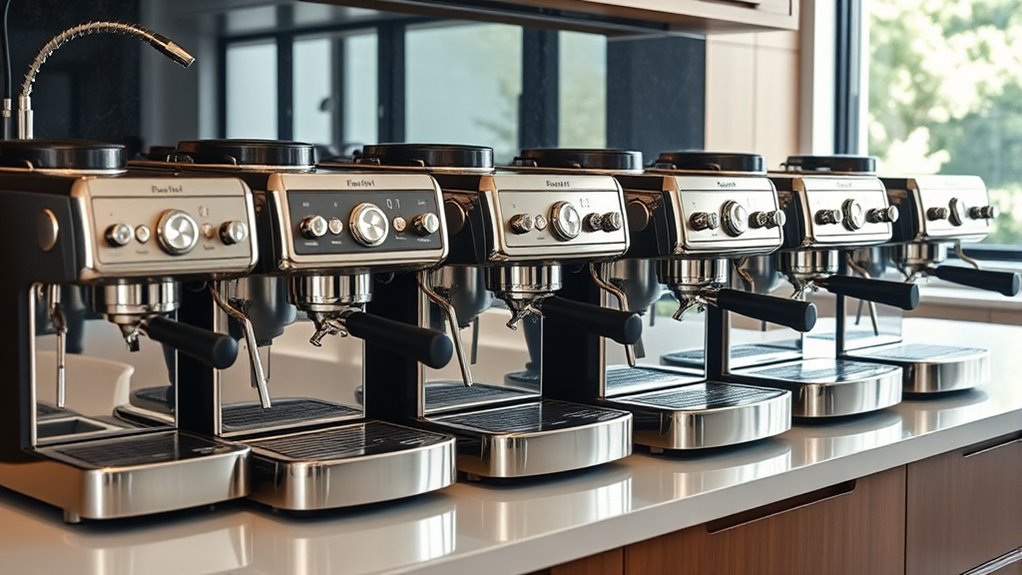

For a strong all-around choice among high-end espresso machines, I’d start with the Breville Barista Pro, which pairs an integrated grinder with a quicker, more guided workflow than traditional semi-automatic machines. The Rancilio Silvia Pro X stands out for buyers who want more hands-on control, while the De’Longhi Dinamica Plus suits households that value one-touch drinks over manual preparation. The main tradeoff is between convenience and control: fully automatic machines simplify each cup, while semi-automatic models ask for more practice and cleanup. Footprint, milk steaming, and grinder needs also separate these picks. Read on for the full breakdown and help matching a machine to your routine.

Get the little things that make your day delivered free with Prime
- Fast, free delivery on millions of items
- Prime Video, Amazon Music and more included
- Member-only deals all year
Complete the kit


Key Takeaways
- Integrated grinders define the lineup’s convenience picks: the Barista Pro, Barista Express models, La Specialista Arte Evo, and Ninja Luxe Café Premier reduce the need to buy a separate grinder, but each offers a different level of control.
- Automation changes the daily routine more than a long feature list does: the Dinamica Plus and Gaggia Accademia prioritize button-led drink making, while the Rancilio Silvia Pro X and Gaggia Classic Evo Pro suit owners who want to manage more of the process.
- Compact machines involve workflow tradeoffs: the Bambino and RIOSKY save counter space, but buyers should weigh their smaller format against the broader controls and capacity of larger machines.
- Milk-drink priorities split the field: the Bambino Plus emphasizes easier milk preparation, while machines with traditional steam wands leave more room for manual technique.
- A premium machine is not automatically a better match: the Silvia Pro X offers a more control-focused route, but a beginner or a household making drinks at the touch of a button may be better served by a simpler or fully automatic pick.
| Breville Barista Express Espresso Machine, Black Truffle |  | Best All-in-One Manual Pick | Model: BES870BTR | Operation: Semi-automatic | Grinder: Integrated precision conical burr grinder | VIEW ON AMAZON | See Our Full Breakdown |
| Breville Barista Express Impress Espresso Machine, Brushed Stainless Steel |  | Best for Assisted Tamping | Operation: Semi-automatic | Grinder: Integrated conical burr grinder with 25 settings | Water tank: 2 L | VIEW ON AMAZON | See Our Full Breakdown |
| Breville Bambino Espresso Machine, Brushed Stainless Steel |  | Best Compact Espresso Machine | Operation: Semi-automatic | Heating system: ThermoJet; reaches extraction temperature in 3 seconds | Temperature control: Digital PID | VIEW ON AMAZON | See Our Full Breakdown |
| De’Longhi Dinamica Plus Fully Automatic Espresso Machine |  | Best One-Touch Convenience | Operation: Fully automatic | Drink recipes: 24+ | Grinder: Built-in conical burr grinder with 13 settings | VIEW ON AMAZON | See Our Full Breakdown |
| Breville Bambino Plus Semi-Automatic Espresso Machine, Brushed Stainless Steel |  | Best for Easy Milk Drinks | Model: BES500BSS | Operation: Semi-automatic | Heating system: ThermoJet | VIEW ON AMAZON | See Our Full Breakdown |
| Breville BES840XL Infuser Espresso Machine, Brushed Stainless Steel |  | Best for Controlled Manual Brewing | Model: BES840XL | Operation: Manual | Power: 1650 W listed in specifications | VIEW ON AMAZON | See Our Full Breakdown |
| Gemilai Owl G3006 Semi-Automatic Espresso Machine with Steam Wand, Ivory White |  | Best for Adjustable Touchscreen Brewing | Model: G3006 | Machine type: Semi-automatic espresso machine | Pump pressure: 15 bar | VIEW ON AMAZON | See Our Full Breakdown |
| RIOSKY Compact Espresso Machine with Steam Wand and PID Temperature Control |  | Best Compact Pick | Machine type: Semi-automatic espresso machine | Power: 1400 W | Pump pressure: 20 bar | VIEW ON AMAZON | See Our Full Breakdown |
| Gaggia Accademia Fully Automatic Espresso Machine, Brushed Stainless Steel |  | Best for One-Touch Drink Variety | Model: RI9781/46 | Machine type: Super-automatic espresso machine | Beverage settings: 19 | VIEW ON AMAZON | See Our Full Breakdown |
| Rancilio Silvia Pro X Espresso Machine |  | Best for Serious Brew-and-Steam Control | Machine type: Semi-automatic espresso machine | Boilers: 1 L steam boiler and 300 mL brew boiler | Water tank: 2 L | VIEW ON AMAZON | See Our Full Breakdown |
| Gaggia Classic Evo Pro Espresso Machine, Brushed Stainless Steel | 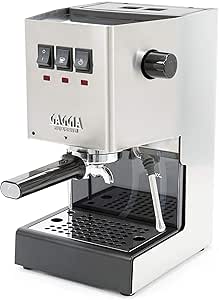 | Best for Hands-On Espresso | Model: RI9380/46 | Operation: Semi-automatic | Extraction pressure: 9 bar | VIEW ON AMAZON | See Our Full Breakdown |
| Breville Barista Touch Espresso Machine, Brushed Stainless Steel (BES880BSS) |  | Best for Guided Café-Style Drinks | Model: BES880BSS | Operation: Fully automatic | Grinder: Integrated precision conical burr grinder | VIEW ON AMAZON | See Our Full Breakdown |
| De’Longhi La Specialista Arte Evo Espresso Machine with Coffee Grinder |  | Best for Espresso and Quick Cold Brew | Operation: Semi-automatic | Grinder: Built-in conical burr grinder with 15 settings | Beverage presets: Espresso, Americano, cold brew, and hot water | VIEW ON AMAZON | See Our Full Breakdown |
| Ninja Luxe Café Premier 3-in-1 Espresso Machine, Drip Coffee Maker, and Cold Brew System |  | Best for One Machine Across Coffee Styles | Operation: Fully automatic | Coffee styles: 2 espresso styles, 3 drip coffee styles, and 2 cold brew styles | Grinder: Built-in conical burr grinder with 25 settings | VIEW ON AMAZON | See Our Full Breakdown |
| Breville Barista Pro Espresso Machine with Grinder, Brushed Stainless Steel |  | Best for Manual Control with an Integrated Grinder | Model: BES878BSS | Operation: Manual espresso machine | Grinder: Integrated precision conical burr grinder | VIEW ON AMAZON | See Our Full Breakdown |
| highend espresso machines under | Dimensions | Operation | Weight | Water tank |
|---|---|---|---|---|
| Breville Barista Express Espre | 13.8 × 12.5 × 15.9 in (D × W × H) | Semi-automatic | 22.1 lb | 67 fl oz |
| Breville Barista Express Impre | 12.5 × 14.5 × 16.5 in (D × W × H) | Semi-automatic | 23.7 lb | 2 L |
| Breville Bambino Espresso Mach | 13.7 × 6.3 × 12 in | Semi-automatic | 10.9 lb | — |
| De’Longhi Dinamica Plus Fully | 16.9 × 9.3 × 13.7 in | Fully automatic | 21.7 lb | — |
| Breville Bambino Plus Semi-Aut | 7.6 × 12.5 × 12.2 in (D × W × H) | Semi-automatic | — | — |
| Breville BES840XL Infuser Espr | 10.12 × 12.28 × 13.15 in | Manual | 17.4 lb | 61 oz (1.7 L) |
| Gemilai Owl G3006 Semi-Automat | 14.57 × 9.23 × 15.47 in (D × W × H) | — | — | 57 oz |
| RIOSKY Compact Espresso Machin | 11.4 × 5.3 × 11.4 in | — | 7.2 lb | 57.5 oz |
| Gaggia Accademia Fully Automat | 16.5 × 11.1 × 15.2 in | — | 13.8 kg | — |
| Rancilio Silvia Pro X Espresso | 16.5 × 10 × 15.2 in (D × W × H) | — | — | 2 L |
| Gaggia Classic Evo Pro Espress | 8 × 9.5 × 14.2 in (D × W × H) | Semi-automatic | 20 pounds | — |
| Breville Barista Touch Espress | 12.7 × 15.5 × 16 in (D × W × H) | Fully automatic | 21.8 lbs | 67 oz |
| De’Longhi La Specialista Arte | 14.4 × 11.2 × 15.9 in (D × W × H) | Semi-automatic | 25.8 lbs | 56 fl oz |
| Ninja Luxe Café Premier 3-in-1 | 12.99 × 13.39 × 14.57 in (D × W × H) | Fully automatic | — | — |
| Breville Barista Pro Espresso | 13 × 14 × 16 in (D × W × H) | Manual espresso machine | 19.5 pounds | 67 oz (2 liters) |
More Details on Our Top Picks
Breville Barista Express Espresso Machine, Black Truffle
I’d choose the Barista Express for a home setup that needs both a grinder and hands-on espresso controls in one machine. Its integrated conical burr grinder sends fresh grounds straight to the portafilter, while PID temperature control and low-pressure pre-infusion support more controlled extraction. Compared with the Barista Express Impress, this model leaves dosing and tamping more fully to you, so it suits buyers who want to shape their routine rather than rely on extra assistance. The manual steam wand can produce microfoam for milk drinks, but texturing milk takes practice. At 22.1 lb and nearly 16 inches tall, it also needs a stable spot on the counter. I’d skip it if convenience matters more than learning espresso technique.
Pros:- Integrated conical burr grinder doses fresh grounds directly into the portafilter.
- PID temperature control and low-pressure pre-infusion support controlled extraction.
- Manual steam wand allows hands-on milk texturing for cappuccinos and latte art.
- Includes a portafilter, milk jug, filters, and cleaning accessories.
Cons:- Manual dosing, tamping, and milk texturing require practice.
- Its full-size footprint and 22.1 lb weight make it less suited to compact counters.
Best for: Home espresso drinkers who want an integrated grinder and are willing to learn dosing, tamping, and manual milk steaming.
Not ideal for: Buyers who want automatic milk preparation or assisted tamping, or who have little counter space for a full-size machine.
- Model:BES870BTR
- Operation:Semi-automatic
- Grinder:Integrated precision conical burr grinder
- Water tank:67 fl oz
- Bean hopper:1/2 lb
- Power:1600 W
- Dimensions:13.8 × 12.5 × 15.9 in (D × W × H)
- Weight:22.1 lb
Our verdict“Choose the Barista Express if you want grinder-to-shot control in one machine and don’t mind learning the manual steps.”
Breville Barista Express Impress Espresso Machine, Brushed Stainless Steel
The Barista Express Impress keeps the grinder-and-portafilter workflow of the Barista Express but adds assisted dosing and tamping, reducing two common sources of inconsistency for newer home baristas. Its integrated grinder offers 25 settings, and PID-controlled heating supports steady extraction; a hot-water function also makes Americanos without a separate kettle. Compared with the regular Barista Express, the Impress is better suited to someone who wants help repeating the preparation steps, though it still calls for manual espresso-making and milk steaming. The machine weighs 23.7 lb, so it is not an easy choice for a counter that needs to be cleared often. I’d favor it over the compact Bambino when an integrated grinder and guided puck prep matter more than saving space.
Pros:- Assisted dosing and tamping simplify puck preparation.
- Integrated conical burr grinder has 25 settings for adjusting grind size.
- PID-controlled heating supports regulated espresso extraction.
- Hot-water function and steam wand cover Americanos and milk-based drinks.
Cons:- Still requires manual operation and practice, including milk texturing.
- At 23.7 lb, it is heavy to move and takes a substantial counter space.
Best for: Newer espresso makers who want an integrated grinder and more repeatable dosing and tamping without moving to a fully automatic machine.
Not ideal for: Small-kitchen buyers or anyone seeking one-touch drinks and automatic milk frothing.
- Operation:Semi-automatic
- Grinder:Integrated conical burr grinder with 25 settings
- Water tank:2 L
- Bean hopper:250 g
- Power:1600 W
- Dimensions:12.5 × 14.5 × 16.5 in (D × W × H)
- Weight:23.7 lb
- Included accessories:54 mm portafilter, 480 ml milk jug, filter baskets, water filter, trimming tool, and cleaning tablets
Our verdict“Pick the Impress if you want grinder-to-shot convenience with tamping assistance but still want to make espresso by hand.”
Breville Bambino Espresso Machine, Brushed Stainless Steel
The Bambino makes the most sense when counter width is the limiting factor: at just 6.3 inches wide, it takes far less room than the grinder-equipped Barista Express models. Its ThermoJet system reaches extraction temperature in three seconds, while PID control and low-pressure pre-infusion bring useful shot-making features to a compact, standalone machine. The tradeoff is that there’s no built-in grinder, so you’ll need ground coffee or a separate grinder, unlike the Barista Express. It is also semi-automatic: you still handle preparation and use the steam wand yourself. The 47 fl oz water capacity is smaller than the Barista Express’s tank, though the lighter 10.9 lb body is easier to reposition. I’d choose this over the Bambino Plus when compact size matters more than automatic milk texturing.
Pros:- Narrow 6.3-inch width fits counters where larger machines may not.
- ThermoJet system reaches extraction temperature in three seconds.
- PID temperature control and low-pressure pre-infusion support controlled shots.
- Includes a steam wand, milk jug, portafilter, and filter baskets.
Cons:- No built-in grinder, so fresh-bean preparation requires separate equipment.
- Manual espresso preparation and milk steaming take hands-on effort.
- 47 fl oz water capacity is smaller than the Barista Express’s tank.
Best for: Apartment dwellers and coffee drinkers with a narrow counter who already own a grinder or use pre-ground coffee.
Not ideal for: Buyers who want a built-in grinder, assisted preparation, or automatic milk frothing.
- Operation:Semi-automatic
- Heating system:ThermoJet; reaches extraction temperature in 3 seconds
- Temperature control:Digital PID
- Pre-infusion:Low-pressure
- Portafilter:54 mm
- Water capacity:47 fl oz
- Dimensions:13.7 × 6.3 × 12 in
- Weight:10.9 lb
Our verdict“Choose the Bambino when compact size and quick heat-up matter more than an integrated grinder or automatic milk frothing.”
De’Longhi Dinamica Plus Fully Automatic Espresso Machine
The Dinamica Plus is the convenience-first choice here: it grinds beans, prepares more than 24 one-touch or customizable drinks, and froths milk automatically with three foam settings. Its touchscreen and up to four user profiles make it a stronger fit for households with different drink routines than the manual Breville machines, which ask each user to manage more of the process. Dishwasher-safe parts also reduce some cleanup work. The tradeoff is less hands-on control over preparation, and its built-in grinder requires whole beans rather than pre-ground coffee. At 16.9 inches deep, it needs more counter depth than the Bambino. I’d pick it over the Barista Express Impress when speed and drink variety matter more than practicing manual puck preparation and milk steaming.
Pros:- Prepares more than 24 one-touch or customizable drinks.
- Automatic milk system offers three foam settings, including options for milk alternatives.
- Up to four user profiles can store different drink preferences.
- Dishwasher-safe parts simplify some cleanup tasks.
Cons:- Its 16.9-inch depth requires more counter space than the Bambino.
- Built-in grinder requires whole-bean coffee, limiting use of pre-ground coffee.
- Fully automatic preparation offers less hands-on control than the semi-automatic Breville machines.
Best for: Households with multiple coffee drinkers who want customizable one-touch drinks and automatic milk frothing.
Not ideal for: Espresso hobbyists who want hands-on control over grinding and preparation, or kitchens with limited counter depth.
- Operation:Fully automatic
- Drink recipes:24+
- Grinder:Built-in conical burr grinder with 13 settings
- Milk frothing:Automatic LatteCrema system with 3 settings
- User profiles:Up to 4
- Display:3.5-inch TFT touchscreen
- Dimensions:16.9 × 9.3 × 13.7 in
- Weight:21.7 lb
Our verdict“Choose the Dinamica Plus if your priority is a broad menu of customizable drinks with minimal manual preparation.”
Breville Bambino Plus Semi-Automatic Espresso Machine, Brushed Stainless Steel
The Bambino Plus keeps the compact footprint and three-second ThermoJet warm-up of the Bambino, but its defining advantage is an automatic steam wand that adjusts milk temperature and texture. That makes it a more approachable pick for regular lattes and cappuccinos than the standard Bambino, where milk texturing stays manual. It also offers PID temperature control and low-pressure pre-infusion, so the convenience is focused on milk rather than replacing the espresso workflow. Like the Bambino, it has no built-in grinder, so fresh-bean drinkers need separate equipment; the Barista Express includes a grinder but occupies more counter space and asks for manual steaming. Its settings are limited to one- or two-cup options, which may not suit buyers seeking broader drink customization.
Pros:- Automatic steam wand adjusts milk temperature and texture for milk-based drinks.
- ThermoJet system reaches operating temperature in three seconds.
- Compact 7.6-inch depth fits smaller counters.
- PID temperature control and low-pressure pre-infusion support controlled extraction.
Cons:- No built-in grinder, unlike the Barista Express.
- Semi-automatic espresso preparation still requires ground coffee and hands-on steps.
- Limited to one- or two-cup settings.
Best for: Small-kitchen owners who make milk-based drinks often and want automated milk texture without a fully automatic machine.
Not ideal for: Buyers who want an integrated grinder, a wide range of drink programs, or full control over milk steaming.
- Model:BES500BSS
- Operation:Semi-automatic
- Heating system:ThermoJet
- Heat-up time:3 seconds
- Portafilter size:54 mm
- Coffee dose:19 g
- Dimensions:7.6 × 12.5 × 12.2 in (D × W × H)
- Milk frothing:Automatic steam wand with adjustable temperature and texture
Our verdict“Choose the Bambino Plus if you want a compact semi-automatic machine that takes much of the guesswork out of steaming milk.”
Breville BES840XL Infuser Espresso Machine, Brushed Stainless Steel
The Infuser is a strong fit for buyers who want hands-on espresso control without stepping up to a dual-boiler machine. Its low-pressure pre-infusion and adjustable PID temperature help support more even extraction, while volumetric shot buttons make repeatable single or double servings easier. Compared with the Breville Bambino, the Infuser offers more explicit temperature adjustment and a larger tank, but it takes up more room and still asks you to manage grinding, tamping, and milk steaming yourself. The steam wand can produce microfoam for milk drinks, though learning the technique takes practice. Its included baskets, jug, and cleaning tools give a new home barista a useful starting kit. I would skip it if convenience matters more than manual control or if you want simultaneous brewing and steaming.
Pros:- Low-pressure pre-infusion supports more even extraction
- PID temperature adjustment in 2°F increments offers useful brew control
- Steam wand can texture milk for lattes and cappuccinos
- Includes filter baskets, milk jug, cleaning tools, and water filter
Cons:- Manual dosing, tamping, and steaming require practice
- Larger than compact options such as the Breville Bambino
- Product details give conflicting wattage figures of 1600 W and 1650 W
Best for: Home baristas who want adjustable brew temperature, pre-infusion, and manual milk texturing without a separate grinder-and-machine setup.
Not ideal for: Buyers who want one-touch drinks, minimal practice, or a dual-boiler workflow for brewing and steaming at the same time.
- Model:BES840XL
- Operation:Manual
- Power:1650 W listed in specifications
- Water tank:61 oz (1.7 L)
- Dimensions:10.12 × 12.28 × 13.15 in
- Weight:17.4 lb
- Temperature control:Digital PID, adjustable in 2°F increments
- Controls:Single or double shot, volumetric control, manual override
- Warranty:1-year limited
Our verdict“Choose the Infuser if you want meaningful manual brew adjustments and can accept a learning curve and a larger counter footprint.”
Gemilai Owl G3006 Semi-Automatic Espresso Machine with Steam Wand, Ivory White
The G3006 suits buyers who want several brewing variables on the machine itself rather than relying on fixed shot presets. Its touchscreen lets you adjust temperature, pre-infusion, and extraction time, and the thermal-balanced brewing head is designed to support consistent extraction. That gives it a more settings-driven approach than the Breville Infuser, whose controls focus on shot volume and PID temperature adjustment. The tradeoff is that the G3006 still depends on properly ground and tamped coffee, and the listed temperature range and timing controls reward experimentation more than quick, effortless drinks. Its swivel wand and removable tank make milk preparation and routine cleanup more practical. I would choose it over a simpler compact machine only if you are willing to preheat it and refine your puck preparation.
Pros:- Adjustable temperature, pre-infusion, and brewing time provide broad control
- PID and thermal-balanced brewing head target consistent extraction
- Swivel steam wand supports milk drinks
- Removable water tank and drip tray simplify cleaning
Cons:- Good extraction depends on careful grinding and tamping
- Requires adequate preheating for more consistent results
- The stated 3.6-pound capacity measurement is not clearly defined
Best for: Espresso hobbyists who want touchscreen access to brew temperature, pre-infusion duration, and extraction time while using ground coffee.
Not ideal for: Beginners seeking reliable drinks with little setup, or buyers who do not want to manage grind size, tamping, and preheating.
- Model:G3006
- Machine type:Semi-automatic espresso machine
- Pump pressure:15 bar
- Power:1500 W
- Water tank:57 oz
- Brewing temperature range:176–215°F
- Pre-infusion time:0–30 seconds
- Dimensions:14.57 × 9.23 × 15.47 in (D × W × H)
- Interface:Touchscreen dual display
Our verdict“Pick the G3006 if touchscreen adjustment matters more to you than a beginner-friendly, low-effort workflow.”
RIOSKY Compact Espresso Machine with Steam Wand and PID Temperature Control
For a narrow counter, the RIOSKY’s 5.3-inch width is its clearest advantage: it brings a steam wand and temperature controls into a footprint far slimmer than the Breville Infuser. The listed 45-second heat-up and removable 57.5-ounce tank also suit quick home routines, while pre-infusion, hot-water dispensing, and a cold-brew function add flexibility beyond basic espresso. That feature mix is appealing, but the machine’s compact body leaves less room to stage a grinder, tamper, and milk pitcher nearby. Its manual wand also means milk drinks still take practice; touchscreen controls do not make the whole process automatic. I would favor this over the larger Gemilai G3006 when counter width is the deciding factor, but not when workspace or a more established manual workflow matters more.
Pros:- Narrow 5.3-inch width suits restricted counter space
- Listed 45-second heat-up supports a quicker start
- PID and NTC temperature control with pre-infusion
- Removable tank and built-in descaling function simplify maintenance
Cons:- Compact footprint leaves limited room for coffee accessories
- Manual steam wand takes practice for consistent milk texture
- Single-boiler design does not provide separate brew and steam boilers
Best for: Apartment dwellers or coffee drinkers with narrow counters who want a compact machine with a manual steam wand and multiple drink functions.
Not ideal for: Enthusiasts who need generous workspace for accessories or buyers who expect automatic milk texturing and minimal involvement.
- Machine type:Semi-automatic espresso machine
- Power:1400 W
- Pump pressure:20 bar
- Water tank:57.5 oz
- Dimensions:11.4 × 5.3 × 11.4 in
- Weight:7.2 lb
- Coffee input:Ground coffee
- Controls:Touchscreen
- Features:PID and NTC temperature control, pre-infusion, cup warmer, milk frother, cold brew function, built-in descaling
Our verdict“Choose the RIOSKY when counter width is the priority and you still want manual espresso and milk-drink capability.”
Gaggia Accademia Fully Automatic Espresso Machine, Brushed Stainless Steel
The Accademia is the convenience-first choice here: its integrated grinder and 19 customizable beverage settings let households move from beans to a broad menu without the manual preparation required by the Rancilio Silvia Pro X. It also offers two milk routes—an automatic frothing carafe for easier drinks and a commercial steam wand for hands-on texturing. That versatility makes it a different kind of high-end option from the semi-automatic machines in this group, but it also means less direct control over puck preparation and extraction. The supplied description does not give a full set of cleaning or customization details, so buyers should not assume every drink setting offers the same degree of adjustment. Its larger body and more involved system are poor matches for a minimal, compact setup.
Pros:- Integrated grinder supports a bean-to-cup workflow
- 19 customizable beverage settings cover a broad range of drinks
- Includes both an automatic milk carafe and a commercial steam wand
- Touchscreen and auto-clean function support a more guided routine
Cons:- Larger and heavier than manual options such as the Breville Infuser
- Automatic preparation offers less hands-on control over extraction
- The product details do not specify a warm-up time or the scope of beverage customization
Best for: Households with varied coffee preferences that want an integrated grinder, multiple programmed drinks, and both automatic and manual milk options.
Not ideal for: Espresso purists who want direct control over dosing and extraction, or small-kitchen buyers who need a compact machine.
- Model:RI9781/46
- Machine type:Super-automatic espresso machine
- Beverage settings:19
- Power:1400 W
- Capacity:1.6 L
- Dimensions:16.5 × 11.1 × 15.2 in
- Weight:13.8 kg
- Materials:Glass and steel
- Features:Integrated grinder, auto-clean function, milk frother, programmable settings, removable tank, touchscreen
Our verdict“Choose the Accademia if menu variety and bean-to-cup convenience matter more than hands-on espresso control or a compact footprint.”
Rancilio Silvia Pro X Espresso Machine
The Silvia Pro X is the most capable hands-on option in this group for buyers who regularly make milk drinks and want to control the brewing process. Its separate brew and steam boilers allow brewing and steaming at the same time, unlike the single-boiler RIOSKY. Dual PID controls, adjustable low-pressure pre-infusion, and a shot timer give experienced users useful tools for repeatable shots. That control comes with a more deliberate routine: the listed warm-up time is about 15 minutes, and its 16.5-inch depth demands substantial counter space. It also lacks the integrated grinder and programmed drink menu of the Gaggia Accademia, so the buyer supplies more of the workflow. I would pick it for repeatable manual espresso and simultaneous milk preparation, not for one-touch convenience.
Pros:- Separate boilers allow brewing and steaming at the same time
- Dual PID controls support precise brew and steam temperature management
- Adjustable low-pressure pre-infusion and shot timer aid repeatability
- Programmable wake-up and removable 2-liter tank add practical convenience
Cons:- About 15 minutes of warm-up time makes spontaneous use less convenient
- At 16.5 inches deep, it needs substantial counter space
- Manual workflow requires a separate grinder and barista preparation
Best for: Experienced home baristas who make espresso and steamed-milk drinks in sequence and want dual-boiler performance with precise temperature control.
Not ideal for: Buyers who want fast startup, an integrated grinder, automatic drinks, or a shallow machine for a small counter.
- Machine type:Semi-automatic espresso machine
- Boilers:1 L steam boiler and 300 mL brew boiler
- Water tank:2 L
- Temperature control:Dual PID
- Pre-infusion:Adjustable low-pressure
- Power:1000 W
- Dimensions:16.5 × 10 × 15.2 in (D × W × H)
- Warm-up time:About 15 minutes
- Cup clearance:4 in
Our verdict“Choose the Silvia Pro X if you value dual-boiler control and simultaneous steaming more than quick setup or automation.”
Gaggia Classic Evo Pro Espresso Machine, Brushed Stainless Steel
The Gaggia Classic Evo Pro is the pick here for buyers who want a traditional espresso workflow rather than an integrated grinder or touchscreen. Its 58 mm commercial-style portafilter and steam wand give it a more café-oriented setup than the guided Breville Barista Touch, but you supply the grinder and handle dosing, tamping, and milk texturing yourself. That manual control suits someone who wants to learn the process and maintain the machine over time; the self-serviceable design is a practical advantage over more automated all-in-ones. The updated pump mounting is designed for quieter brewing, and the boiler is built to resist scale buildup and corrosion. The tradeoff is clear: this is a focused espresso machine, not an easy one-touch drink station, and its 20-pound weight makes it less appealing if you need to move it often.
Pros:- 58 mm portafilter supports a traditional, café-style workflow
- Steam wand allows hands-on milk texturing and latte art
- Includes single, double, and pressurized filter baskets
- Self-serviceable design and boiler intended to resist scale buildup and corrosion
Cons:- No built-in grinder, so a separate grinder is needed for whole-bean espresso
- Semi-automatic preparation and manual steaming require practice
- At 20 pounds, it is not especially easy to reposition
Best for: Home espresso learners who already own a capable grinder or want to choose one separately, and who are comfortable practicing manual milk steaming.
Not ideal for: Buyers who want an included grinder, guided controls, or automatic milk drinks; the Barista Touch is better suited to a more assisted routine.
- Model:RI9380/46
- Operation:Semi-automatic
- Extraction pressure:9 bar
- Portafilter:58 mm
- Water capacity:2.1 liters
- Power:1200 watts
- Dimensions:8 × 9.5 × 14.2 in (D × W × H)
- Weight:20 pounds
- Origin:Made in Italy
Our verdict“Choose the Gaggia if you want a repairable, hands-on espresso setup with a commercial-style portafilter and do not mind sourcing a grinder separately.”
Breville Barista Touch Espresso Machine, Brushed Stainless Steel (BES880BSS)
The Breville Barista Touch earns its place for buyers who want an integrated grinder and a guided path from beans to milk drinks. Its touchscreen offers five presets and up to eight custom settings, while the automatic steam wand lets users adjust milk temperature and texture without mastering manual steaming first. Compared with the manual Breville Barista Pro, the Touch shifts more of the drink-making routine into assisted controls; the Pro gives a more hands-on workflow and displays grinding and extraction progress instead. A three-second ThermoJet heat-up also helps when time is tight, and PID control supports consistent temperature management. The compromise is less emphasis on manual technique and flexibility than the Gaggia Classic Evo Pro. It also requires whole beans for its built-in grinder, and the supplied capacity information conflicts, so I would not rely on the listed bean-hopper figure.
Pros:- Integrated conical burr grinder doses coffee on demand
- Touchscreen supports five presets and up to eight personalized settings
- Automatic steam wand offers adjustable milk temperature and texture
- ThermoJet heating system reaches extraction temperature in three seconds
Cons:- Built-in grinder requires whole coffee beans
- Less hands-on control than the Barista Pro or Gaggia Classic Evo Pro
- Product information gives conflicting bean-hopper capacity figures
Best for: Busy home coffee drinkers who want fresh-ground espresso, repeatable saved drinks, and automatic milk texturing with limited manual practice.
Not ideal for: Buyers who prefer a fully manual workflow, use pre-ground coffee, or want a compact machine; the Gaggia Classic Evo Pro offers a simpler, more hands-on setup.
- Model:BES880BSS
- Operation:Fully automatic
- Grinder:Integrated precision conical burr grinder
- Heating system:ThermoJet; 3-second heat-up
- Temperature control:PID
- Display:Touchscreen; up to 8 custom settings and 5 pre-programmed favorites
- Water tank:67 oz
- Dimensions:12.7 × 15.5 × 16 in (D × W × H)
- Weight:21.8 lbs
Our verdict“Pick the Barista Touch for a fast, customizable bean-to-milk-drink routine where touchscreen guidance matters more than manual control.”
De’Longhi La Specialista Arte Evo Espresso Machine with Coffee Grinder
The La Specialista Arte Evo is the most distinctive choice here for households that want espresso equipment with a quick cold-brew option. Its built-in conical burr grinder has 15 settings, and the machine can prepare cold brew in under five minutes—capabilities the espresso-focused Gaggia Classic Evo Pro does not offer. Four presets cover espresso, Americano, cold brew, and hot water, while the steam wand gives milk-drink makers room to work on microfoam. This is still a semi-automatic machine, though, so the presets do not remove the hands-on preparation involved in making espresso. It also weighs 25.8 pounds, making it the heaviest pick in this five-product group. Compared with the more automated Ninja Luxe Café Premier, the De’Longhi is a better fit for someone prioritizing espresso preparation over a broad, guided coffee menu.
Pros:- Built-in conical burr grinder offers 15 settings
- Cold brew preparation takes under five minutes
- Steam wand can produce microfoam for milk drinks
- Four presets include espresso, Americano, cold brew, and hot water
Cons:- Semi-automatic preparation still requires hands-on work
- At 25.8 pounds, it is cumbersome to move
- Its menu is narrower than the Ninja Luxe Café Premier’s espresso, drip, and cold-brew range
Best for: Espresso drinkers who also want a fast cold-brew option, a built-in grinder, and control over manual preparation.
Not ideal for: People seeking a lightweight machine or minimal-effort coffee routine; the Ninja Luxe Café Premier offers more automated drink variety, while this De’Longhi remains hands-on.
- Operation:Semi-automatic
- Grinder:Built-in conical burr grinder with 15 settings
- Beverage presets:Espresso, Americano, cold brew, and hot water
- Cold brew time:Under 5 minutes
- Pump pressure:15 bar
- Temperature settings:3
- Water tank:56 fl oz
- Dimensions:14.4 × 11.2 × 15.9 in (D × W × H)
- Weight:25.8 lbs
Our verdict“Choose this De’Longhi if quick cold brew and espresso control matter more than a lightweight build or fully guided operation.”
Ninja Luxe Café Premier 3-in-1 Espresso Machine, Drip Coffee Maker, and Cold Brew System
The Ninja Luxe Café Premier makes the strongest case for buyers who want one appliance to cover espresso, drip coffee, and cold brew. Unlike the espresso-focused Breville Barista Pro, this 3-in-1 machine serves several brewing styles and accepts either whole beans or ground coffee. Its 25-setting grinder and Barista Assist Technology guide grinding, dosing, tamping, and brewing, reducing the number of steps a beginner must learn. The dual froth system also handles hot or cold foam, while the removable 70 oz reservoir supports a less frequent refill routine. That breadth comes with a tradeoff: this is a broader coffee station rather than a focused manual espresso machine, so buyers seeking a traditional workflow may prefer the Gaggia Classic Evo Pro. The product data also lists a substantial footprint, making counter space a key part of the decision.
Pros:- Makes espresso, drip coffee, and cold brew in one appliance
- Barista Assist Technology guides grinding, dosing, tamping, and brewing
- Built-in conical burr grinder has 25 settings
- Automatic system creates hot or cold foam
Cons:- Its multi-style design takes more counter space than a focused espresso machine
- Guided automation offers a different experience from hands-on espresso preparation
- Requires a 120 V power supply
Best for: Households with varied coffee preferences that want espresso, drip, and cold brew from one guided machine and have room to keep it on the counter.
Not ideal for: Espresso purists who want a focused manual setup, or buyers with limited counter space; the Gaggia Classic Evo Pro is more dedicated to espresso.
- Operation:Fully automatic
- Coffee styles:2 espresso styles, 3 drip coffee styles, and 2 cold brew styles
- Grinder:Built-in conical burr grinder with 25 settings
- Coffee input:Ground coffee and whole beans
- Frother:Dual Froth System with automatic steamer and magnetic whisk
- Water reservoir:70 oz, removable
- Power:1650 watts
- Dimensions:12.99 × 13.39 × 14.57 in (D × W × H)
- Voltage:120 V
Our verdict“Choose the Ninja if your household values several coffee styles and guided preparation more than a dedicated manual espresso experience.”
Breville Barista Pro Espresso Machine with Grinder, Brushed Stainless Steel
The Breville Barista Pro suits buyers who want to dial in espresso themselves but do not want to buy a separate grinder. Its integrated conical burr grinder, PID temperature control, and LCD progress display support a more hands-on routine than the touchscreen-led Barista Touch, while still keeping grinding and brewing in one machine. The ThermoJet system reaches extraction temperature in three seconds, which can make short coffee breaks more practical. Manual milk steaming also leaves room to develop microfoam technique instead of handing texture control to an automatic wand. That freedom brings a learning curve: dosing, extraction, and milk preparation remain the user’s responsibility. Compared with the Gaggia Classic Evo Pro, the Barista Pro includes a grinder and progress display, but it is less of a separate-component setup for buyers who want to choose their own grinder.
Pros:- Integrated conical burr grinder provides coffee on demand
- ThermoJet heating system reaches extraction temperature in three seconds
- PID control is specified at ±2°C
- LCD shows grinding and extraction progress
Cons:- Manual operation requires practice with dosing, extraction, and milk steaming
- Built-in grinder limits buyers who want to select a separate grinder
- Requires a 120 V power supply
Best for: Home baristas who want to adjust grind and extraction, value fast heat-up, and prefer an integrated grinder over buying separate equipment.
Not ideal for: People who want one-touch drinks or automatic milk texture; the Barista Touch offers a more assisted routine.
- Model:BES878BSS
- Operation:Manual espresso machine
- Grinder:Integrated precision conical burr grinder
- Heating system:ThermoJet; 3-second heat-up
- Temperature control:PID, ±2°C
- Bean hopper:1/2 lb
- Water tank:67 oz (2 liters)
- Dimensions:13 × 14 × 16 in (D × W × H)
- Weight:19.5 pounds
Our verdict“Pick the Barista Pro if you want an integrated grinder and fast heat-up without giving up hands-on control of espresso and milk.”

How We Picked
I compared these machines around the decisions that shape everyday espresso: how much work each cup requires, whether a grinder is built in, how much control the user has, and how the machine handles milk drinks. I also weighed counter space, maintenance demands, and how steep the learning curve is likely to feel for a new home barista. A feature matters here only when it changes the buyer’s routine, not simply because it appears on a specification sheet.
The ranking favors machines with a clear role and a useful balance of capability and usability. Versatile semi-automatic options rank well when they combine a practical workflow with room to improve, while automatic machines earn their place for reducing hands-on work. More specialized machines rank for the buyers who will use their particular strengths; they sit lower as general recommendations when their extra control, size, or learning demands will not benefit every household. Since the requested keyword does not specify a price ceiling, I compare capabilities and tradeoffs rather than imply a spending cutoff.
| highend espresso machines under | Operation |
|---|---|
| Breville Barista Express Espre | Semi-automatic |
| Breville Barista Express Impre | Semi-automatic |
| Breville Bambino Espresso Mach | Semi-automatic |
| De’Longhi Dinamica Plus Fully | Fully automatic |
| Breville Bambino Plus Semi-Aut | Semi-automatic |
| Breville BES840XL Infuser Espr | Manual |
| Gemilai Owl G3006 Semi-Automat | — |
| RIOSKY Compact Espresso Machin | — |
| Gaggia Accademia Fully Automat | — |
| Rancilio Silvia Pro X Espresso | — |
| Gaggia Classic Evo Pro Espress | Semi-automatic |
| Breville Barista Touch Espress | Fully automatic |
| De’Longhi La Specialista Arte | Semi-automatic |
| Ninja Luxe Café Premier 3-in-1 | Fully automatic |
| Breville Barista Pro Espresso | Manual espresso machine |
Factors to Consider When Choosing Highend Espresso Machines Under
Before choosing, decide what you want the machine to take off your hands—and what parts of making espresso you want to control. A machine’s daily fit often depends less on its feature count than on its grinder arrangement, milk routine, available counter space, and tolerance for cleaning.
Choose Your Workflow Before Comparing Features
Start by deciding whether you want to make each drink manually, follow guided steps, or press a button and let the machine handle most of the process. Semi-automatic machines give you more say over grinding, dosing, and extraction, but that freedom comes with a learning curve and more cleanup. Guided machines can shorten the path to a repeatable drink without removing every adjustment. Fully automatic models suit people who value speed and convenience, though they offer less hands-on involvement. A common mistake is buying for an imagined weekend hobby rather than the routine you’ll actually keep. If several people with different skill levels will use the machine, prioritize a workflow everyone can comfortably repeat.
Decide Whether an Integrated Grinder Is a Benefit
An integrated grinder reduces equipment clutter and makes a single-machine setup easier, but it also ties the grinder and espresso machine into one purchase. Separate grinders offer more flexibility if you later want to upgrade one part without replacing the other. Think about where beans will be stored and whether you expect to change coffee often; frequent bean changes can make grinder cleanup more relevant. Don’t assume a built-in grinder means no learning is needed, since grind size and dose still affect the cup on many semi-automatic models. If you already own a capable grinder, a machine without one may be the more sensible fit. If you’re starting from scratch, an integrated setup can simplify the first purchase and the counter layout.
Match Milk Preparation to Your Drinks
Buyers making mostly straight espresso have little reason to pay extra for milk features they rarely use. For frequent lattes and cappuccinos, compare whether you prefer an assisted or automatic routine or want to steam milk by hand with a wand. Manual steaming can give you more control over texture, but it takes practice and adds a step to every milk drink. Automatic or guided milk functions reduce effort, although they may limit how much you can tailor the result. Consider how many milk drinks you make back to back, since the time and cleanup involved can matter more than a single feature. Match the machine to your household’s usual order, not just the most elaborate drink you might make occasionally.
Measure the Full Counter Footprint
Measure the space where the machine will sit, including room to open any top-loading bean hopper or remove a water tank. The machine itself is only part of the footprint: a tamper, knock box, milk pitcher, and separate grinder can all claim counter space. Compact machines may fit neatly but can involve smaller working areas or fewer conveniences during preparation. Larger all-in-one and automatic machines can reduce accessory clutter while taking up more permanent space. Check how you’ll access the machine for refilling and cleaning rather than measuring only the outer width. A tight fit can make routine maintenance irritating enough to discourage daily use.
Account for Cleaning and Maintenance
Every espresso machine needs regular attention, but the tasks differ by design. Milk systems need prompt cleaning after use, while machines with grinders add grounds and bean-hopper care to the routine. Automatic machines may perform some cleaning steps themselves, yet their internal pathways and removable components still need the care described by the manufacturer. Before buying, check how easily the drip tray, water tank, and brew components can be reached and removed. Don’t confuse fewer manual steps with no upkeep. A machine that suits your tolerance for maintenance is more likely to stay in your daily rotation.
Pay for Control Only If You’ll Use It
Extra control can reward a curious home barista, but it has little value if you mainly want a consistent drink with minimal adjustments. More hands-on machines may ask you to learn dosing, tamping, grind changes, and milk technique before results become repeatable. Beginners can avoid frustration by valuing clear controls and a forgiving workflow over a long list of adjustments. Experienced users may prefer the ability to fine-tune preparation, even if it means spending more time per shot. A useful rule is to pay for capabilities connected to habits you already have or genuinely want to develop. Don’t choose the most involved machine simply because it appears to offer the most room to grow.
Frequently Asked Questions
Should I choose a semi-automatic or fully automatic machine for a shared household?
Choose based on the least hands-on user who will make coffee regularly, not only the person most interested in espresso. A semi-automatic machine offers more control but asks each user to manage preparation and cleanup. A fully automatic machine can make everyday drinks simpler for a household with varied experience or limited time. If one person wants to refine technique while others want quick drinks, consider whether both workflows can realistically coexist in your kitchen. The best shared choice is the one everyone will use without needing someone else to operate it.
Is an espresso machine with a built-in grinder the right choice if I already own a grinder?
Not necessarily. If your current grinder is suitable for espresso and you’re happy with its results, a machine without an integrated grinder can avoid duplicating equipment. A built-in grinder can still make sense if you want a tidier setup or prefer an all-in-one workflow, but compare its convenience against the flexibility of keeping components separate. Also check how much counter space your existing grinder occupies. The right choice depends on whether a simpler footprint or easier future upgrades matter more to you.
Which kind of machine makes sense if I mostly drink lattes?
Focus first on the milk workflow, then on espresso controls. If you make milk drinks often, an assisted milk routine may be more useful than extensive manual shot adjustments. A traditional steam wand is a better fit if you want to learn milk texture and control it yourself, but it adds practice and cleanup. Think about whether you make one drink at a time or prepare several in a row, since repeated steaming affects the pace of your routine. Buyers who drink mostly straight espresso should not let milk features drive the whole decision.
Can a compact espresso machine be a good long-term choice?
Yes, if its smaller footprint matches your kitchen and its workflow matches your expectations. Compact machines can be a practical daily choice for people who value space and do not need every adjustment or accessory in one unit. The tradeoff may show up in preparation room, capacity, or the number of built-in conveniences. Check access to the water tank and cleaning parts before deciding that a machine will fit. If your interest in espresso grows, decide whether you would rather upgrade later or buy a more involved setup from the start.
Does buying a more control-focused machine guarantee better espresso?
No. More control gives you more ways to adjust a shot, but it also gives you more variables to manage. Consistent results depend on the coffee, grinder, preparation, and willingness to learn the machine’s workflow. A guided or automatic model may serve a busy buyer better even if it offers fewer manual adjustments. Choose a control-focused machine because you want to practice and tune your routine, not because you expect complexity alone to improve every cup. For a household that values repeatability, ease of use may matter more than the breadth of adjustments.
Conclusion
For the best overall balance, I’d choose the Breville Barista Pro for its integrated grinder and more guided semi-automatic workflow. The best value in capability depends on your setup: the Bambino is a compact route if you already have a grinder, while the Barista Express brings grinding into the machine. For a premium, control-focused pick, the Rancilio Silvia Pro X is better suited to buyers who want a more hands-on routine; beginners should look first at the Bambino Plus or a guided option rather than starting with the most demanding workflow. If convenience is the priority, consider the De’Longhi Dinamica Plus or Gaggia Accademia; if counter space is tight, compare the Bambino and RIOSKY. Pick the machine that fits how you make coffee on an ordinary morning, not only the features you might use someday.
Fall Picks
fall essentials
As an affiliate, we earn on qualifying purchases.