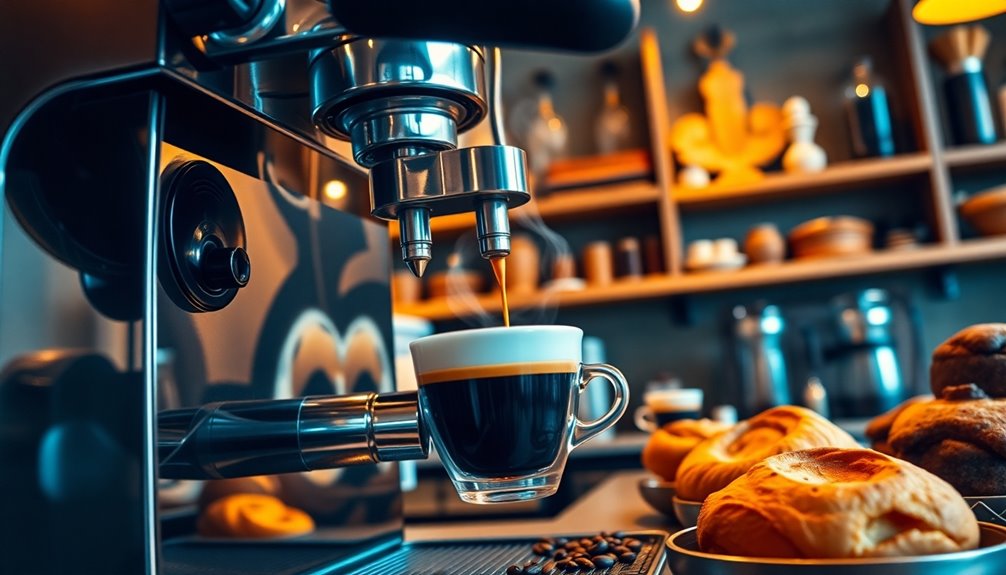
The best espresso machine for a small coffee shop in this roundup is the Gaggia Classic Evo Pro, a hands-on pick for low-volume service where control matters more than automation. The Breville Barista Express is a strong value choice because its built-in grinder keeps the workflow compact, while the Breville Bambino suits a tight counter and a short drink menu. The main tradeoff is that these are largely home-oriented machines, not equipment built for a sustained café rush. I weigh workflow, milk-drink capacity, footprint, and ease of upkeep so you can judge whether a compact machine fits your expected volume. Read on for the full comparison and picks by shop type.

Get the little things that make your day delivered free with Prime
- Fast, free delivery on millions of items
- Prime Video, Amazon Music and more included
- Member-only deals all year
Complete the kit


Key Takeaways
- The Gaggia Classic Evo Pro leads for hands-on, low-volume service, but its manual workflow and single-group format make it a poor match for a busy rush.
- The Breville Barista Express offers the most self-contained value-oriented workflow among the established picks here, though a built-in grinder can slow service when multiple drinks queue up.
- The Breville Barista Touch favors guided operation over hands-on control; its assisted interface can help staff consistency, but it does not turn a home machine into commercial-capacity equipment.
- The Bambino and Stilosa make footprint and simplicity priorities, while the Ninja Luxe Café stands apart for shops that want coffee options beyond espresso.
- Several grinder-and-frother models promise all-in-one convenience, but buyers should verify parts support and cleaning demands before relying on an unfamiliar brand for daily business.
| Gaggia Classic Evo Pro Espresso Machine – Brushed Stainless Steel |  | Best for Commercial-Style Control | Housing material: Solid steel | Country of origin: Italy | Extraction pressure: 9 bar | VIEW ON AMAZON | See Our Full Breakdown |
| Espresso Machine with Grinder, Temperature Control, and 44 Grind Settings |  | Best All-in-One Prep | Temperature control range: 190°F–201°F | Grind settings: 44 | Water tank capacity: 60 oz | VIEW ON AMAZON | See Our Full Breakdown |
| atatix Espresso Machine with Milk Frother, 20 Bar Pressure |  | Best Compact Entry Pick | Pressure: 20 bar | Temperature control: NTC precision, 90°C–96°C | Materials: ABS and stainless steel | VIEW ON AMAZON | See Our Full Breakdown |
| Breville Bambino Espresso Machine, Brushed Stainless Steel | 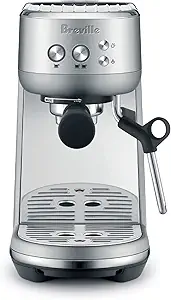 | Best for Fast, Compact Service | Model: BES450BSS | Heating system: ThermoJet | Heat-up time: 3 seconds | VIEW ON AMAZON | See Our Full Breakdown |
| XIXUBX Espresso Machine with Milk Frother |  | Best for Simple Small-Batch Milk Drinks | Pressure: 20 bar | Water tank capacity: 42 oz | Steam wand: 360° rotating and detachable | VIEW ON AMAZON | See Our Full Breakdown |
| Breville Barista Express Espresso Machine, Brushed Stainless Steel |  | Best Integrated Grinder-and-Steam Pick | Power: 1600 watts | Voltage: 120 volts | Bean hopper capacity: 1/2 lb | VIEW ON AMAZON | See Our Full Breakdown |
| AIRMSEN Espresso Machine with Grinder and Milk Frother |  | Best Compact Touchscreen Grinder Pick | Type: Semi-automatic espresso machine | Dimensions: 7.9 × 10.2 × 14.6 inches | Grinder: Conical burr grinder with 10 settings | VIEW ON AMAZON | See Our Full Breakdown |
| Hanrose Espresso Machine with Grinder and Milk Frother |  | Best for a More Café-Style Portafilter Workflow | Operation mode: Semi-automatic | Dimensions: 13.23 × 12.99 × 16.54 inches | Grind settings: 15 | VIEW ON AMAZON | See Our Full Breakdown |
| Arecovas Espresso Machine with Milk Frother, 20 Bar Pressure, Touch Screen |  | Best for the Narrowest Counter | Dimensions: 12 × 5.2 × 11.9 inches | Water tank capacity: 1.2 L (41 oz) | Wattage: 1300 watts | VIEW ON AMAZON | See Our Full Breakdown |
| Lavazza BLUE Classy Mini Single-Serve Espresso Coffee Machine LB 300 |  | Best for a Simple Backup Coffee Station | Dimensions: 5.3 × 13 × 10.2 inches | Coffee selections: 2 | Controls: Touch | VIEW ON AMAZON | See Our Full Breakdown |
| Chefman CraftBrew Digital Espresso Machine with Steam Wand | 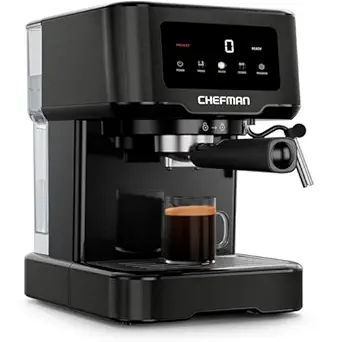 | Best Programmable Compact Pick | Pump pressure: 15 bar | Water capacity: 1.5 liters | Wattage: 1350 watts | VIEW ON AMAZON | See Our Full Breakdown |
| Breville Barista Touch Espresso Machine BES880BSS, Brushed Stainless Steel |  | Best for Customized Espresso Drinks | Power: 1680 watts | Voltage: 110–120 V | Bean hopper capacity: 1/2 lb | VIEW ON AMAZON | See Our Full Breakdown |
| Ninja Luxe Café Premier 3-in-1 Espresso Machine, Drip Coffee & Cold Brew |  | Best for a Broad Café Menu | Water reservoir capacity: 70 oz | Grinder: Conical burr with 25 settings | Froth system: Dual system with four preset programs | VIEW ON AMAZON | See Our Full Breakdown |
| XIXUBX Compact Espresso Machine with Milk Frother |  | Best Space-Saving Milk-Drink Pick | Pressure: 20 bar | Temperature control: PID controller | Brewing time: 22–30 seconds | VIEW ON AMAZON | See Our Full Breakdown |
| De’Longhi Stilosa Compact Manual Espresso Machine with Milk Frother | 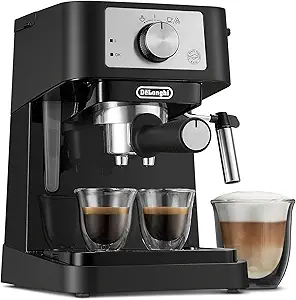 | Best Manual Starter for a Low-Volume Counter | Machine type: Manual espresso machine | Boiler material: Stainless steel | Milk frother: Manual | VIEW ON AMAZON | See Our Full Breakdown |
More Details on Our Top Picks
Gaggia Classic Evo Pro Espresso Machine – Brushed Stainless Steel
The Gaggia Classic Evo Pro is my pick for a small shop where espresso quality and hands-on control matter more than serving a long queue quickly. Its 58 mm portafilter, three-way solenoid valve, and commercial-style steam wand offer a more café-like workflow than the compact Breville Bambino, though the Bambino heats faster and takes up less counter space. The 2.1-liter capacity and sturdy steel housing suit a modest daily workload, but this is still a single-group machine, not a substitute for equipment built for continuous service. There’s no built-in grinder, so budget counter space and workflow time for a separate grinder. I’d choose it for a low-volume shop with a trained operator; busy service periods could outgrow its pace.
Pros:- 58 mm portafilter and three-way solenoid valve support a café-style workflow
- Commercial-style steam wand allows milk texturing for espresso drinks
- Solid steel housing and corrosion-resistant boiler are built for durability
- 2.1-liter capacity reduces the need for frequent refills
Cons:- Separate grinder adds equipment, counter-space, and workflow requirements
- Its single-group format may be slow for sustained rush periods
- At 20 pounds, it is less convenient to reposition than smaller options
Best for: Low-volume cafés with a skilled barista who wants a 58 mm portafilter and hands-on control over espresso and milk preparation
Not ideal for: Busy shops with sustained drink queues or limited counter space, since it has no built-in grinder and is not presented as a high-volume commercial machine
- Housing material:Solid steel
- Country of origin:Italy
- Extraction pressure:9 bar
- Portafilter size:58 mm
- Valve type:Three-way solenoid
- Steam wand:Commercial-style
- Capacity:2.1 liters
- Dimensions:8 in D × 9.5 in W × 14.2 in H
Our verdict“Choose the Gaggia for a modest shop prioritizing traditional espresso control over fast, high-volume service.”
Espresso Machine with Grinder, Temperature Control, and 44 Grind Settings
For a small shop trying to keep the equipment lineup compact, this AMZCHEF combines espresso brewing and grinding in one machine. Its 44 grind settings and adjustable temperature range give an operator more ways to tune coffee than the simpler XIXUBX machine, while the 60 oz water tank means fewer interruptions for refills. The touch screen and one-touch cold brew mode add flexibility, but extra functions can also mean more cleaning and upkeep during a workday. Its 1350 W system and integrated grinder make it a convenient counter setup, not proof of commercial rush-hour capacity. I’d shortlist it for a small, low-volume café that wants to reduce separate equipment; shops with little counter room or a tightly standardized espresso workflow may prefer a simpler machine.
Pros:- Built-in grinder combines two pieces of equipment in one setup
- 44 grind settings allow adjustment for different coffee and brewing preferences
- Temperature control ranges from 190°F to 201°F
- 60 oz tank and included descaling function support routine operation
Cons:- Large footprint may be difficult to accommodate on a small service counter
- Multiple modes and integrated components add cleaning and maintenance tasks
- The supplied details do not establish suitability for sustained commercial volume
Best for: Small cafés with a limited equipment footprint that want an integrated grinder, adjustable brewing temperature, and occasional cold brew
Not ideal for: Shops with very limited counter space or operators who want a simple, easy-to-clean espresso-only workflow
- Temperature control range:190°F–201°F
- Grind settings:44
- Water tank capacity:60 oz
- Power:1350 W
- Steam wand:8 mm stainless steel
- Display:IMD HD touch screen
- Cold brew mode:One-touch
- Descaling function:Included
Our verdict“Pick this AMZCHEF for a small shop that values an integrated grinder and flexible settings more than a stripped-down workflow.”
atatix Espresso Machine with Milk Frother, 20 Bar Pressure
The atatix is the most approachable fit here for a small counter and a shop serving a limited number of espresso drinks. Its compact design, 30-second preheat, and automatic single- or double-shot modes may simplify routine drink preparation compared with the more hands-on Gaggia Classic Evo Pro. Manual extraction is available for adjustment, though its 102-second limit sets a boundary on that control. The steam wand offers milk texturing, but the listed details omit tank capacity and wattage, making it harder to plan refills and service pace than with the AMZCHEF’s stated 60 oz tank. The advertised 20-bar pressure should not be read as a measure of café throughput. I’d consider it for a small, low-volume counter, not a shop expecting frequent back-to-back orders.
Pros:- Compact design is suited to counters with limited available space
- Automatic single- and double-shot modes offer a straightforward brewing option
- NTC temperature control is specified within a 90°C–96°C range
- Steam wand supports milk texturing for milk-based drinks
Cons:- Manual extraction is limited to a maximum of 102 seconds
- No water capacity or wattage is provided in the product details
- The supplied specifications do not establish suitability for continuous shop service
Best for: A small café or coffee counter serving a modest number of drinks and prioritizing a compact machine with automatic shot options
Not ideal for: Shops planning sustained service, or buyers who need documented water capacity and power details before designing a workflow
- Pressure:20 bar
- Temperature control:NTC precision, 90°C–96°C
- Materials:ABS and stainless steel
- Extraction modes:Automatic single/double shot and manual
- Manual extraction limit:Up to 102 seconds
- Preheat time:30 seconds
- Included accessories:Portafilter, funnel, coffee scoop/tamper, and user manual
Our verdict“Choose the atatix for a space-conscious, low-volume setup that values automatic shots over extensive manual control.”
Breville Bambino Espresso Machine, Brushed Stainless Steel
The Breville Bambino suits a small shop where counter space and quick readiness matter. Its three-second heat-up can reduce waiting between startup and the first drink, while PID temperature control and low-pressure pre-infusion give the operator defined tools for extraction. Compared with the Gaggia Classic Evo Pro, the Bambino is quicker to heat and smaller, but its 54 mm portafilter is less aligned with the Gaggia’s 58 mm commercial-style setup. Adjustable milk temperature and texture help with cappuccinos and lattes, and the included baskets support different preparation preferences. It remains a manual machine, so drink consistency depends on a capable operator; its compactness does not make it a high-volume workhorse. I’d choose it for a lean, low-throughput counter, not a busy café line.
Pros:- ThermoJet system reaches extraction temperature in three seconds
- Digital PID temperature control and low-pressure pre-infusion support managed extraction
- Compact body takes up less counter space than larger all-in-one machines
- Adjustable steam settings and included milk jug support milk-drink preparation
Cons:- Manual preparation requires operator practice for consistent drinks
- 54 mm portafilter differs from the Gaggia’s 58 mm commercial-style format
- One-year limited warranty is relatively short for a shop machine
Best for: Small coffee counters with limited space, a trained operator, and a need for quick startup between modest service periods
Not ideal for: High-volume cafés that need commercial-style components or equipment designed for continuous drink output
- Model:BES450BSS
- Heating system:ThermoJet
- Heat-up time:3 seconds
- Temperature control:Digital PID
- Portafilter size:54 mm
- Portafilter dose:19 g
- Power:1560 W
- Voltage:110–120 V
Our verdict“Pick the Bambino for a space-limited shop with light service and an operator comfortable with manual espresso preparation.”
XIXUBX Espresso Machine with Milk Frother
The XIXUBX is a straightforward option for a small counter focused on espresso and milk drinks rather than extensive customization. Its 42 oz water tank and included stainless steel pitcher make it more ready for a small batch of drinks than a bare-bones setup, while the rotating, detachable steam wand can make cleaning and positioning easier. The visible pressure gauge gives the operator a point of reference, but the listed details do not specify temperature control, power, or dimensions. That makes it harder to plan counter placement and repeatable shop routines than with the Breville Bambino, which lists PID control and a defined heating system. The 20-bar figure alone does not indicate service speed. I’d consider this for light service where simple milk drinks are the focus, but not for a shop needing clearly documented workflow specifications.
Pros:- 42 oz water tank supports multiple servings between refills
- Rotating, detachable steam wand offers flexible positioning and easier cleaning
- Stainless steel milk pitcher is included
- Visible pressure gauge gives the operator a brewing reference
Cons:- Dimensions are not specified, making counter-fit planning difficult
- Temperature control and power details are not provided
- One-year warranty may be a limited fit for equipment used daily in a shop
Best for: Small coffee counters serving a modest number of espresso and milk drinks that want a pitcher included and a removable steam wand
Not ideal for: Shops that need documented machine dimensions, temperature settings, or power requirements to plan their counter and workflow
- Pressure:20 bar
- Water tank capacity:42 oz
- Steam wand:360° rotating and detachable
- Included accessory:Stainless steel milk frothing pitcher
- Body material:Stainless steel
- Warranty:1 year
Our verdict“Choose the XIXUBX for light, milk-drink-focused service if its unspecified dimensions and controls fit your shop’s needs.”
Breville Barista Express Espresso Machine, Brushed Stainless Steel
For a small coffee shop serving espresso drinks throughout the day, the Barista Express combines two key steps in one counter unit: grinding into the portafilter and steaming milk. Its integrated conical burr grinder and PID temperature control give staff useful control over dose and extraction, while the steam wand can handle milk drinks and latte-art practice. Compared with the narrower Arecovas, it takes more counter space, but it includes a grinder rather than requiring a separate one. The tradeoff is a hands-on workflow: dialing in grind and tamping takes practice, and a single integrated setup is less flexible than separate café equipment if one component needs attention. I’d choose it for a low-volume shop, not as a machine for sustained commercial rushes.
Pros:- Built-in conical burr grinder sends fresh grounds directly to the portafilter
- PID temperature control supports more consistent shot preparation
- Steam wand can produce micro-foam for milk drinks and latte art
- 67 oz water tank reduces refill frequency compared with smaller-tank options
Cons:- Larger footprint than the Arecovas and other narrow-counter options
- Grind adjustment and tamping require staff training
- Integrated grinder and espresso machine offer less equipment separation than a dedicated grinder-and-machine setup
Best for: A small café with modest drink volume that wants an integrated grinder, manual shot control, and milk steaming in one machine
Not ideal for: Busy shops needing continuous high-volume service or owners with very limited counter space
- Power:1600 watts
- Voltage:120 volts
- Bean hopper capacity:1/2 lb
- Water tank capacity:67 oz
- Grinder:Integrated precision conical burr grinder
- Temperature control:Digital PID regulation
- Pressure system:Low-pressure pre-infusion
- Portafilter:54 mm stainless steel
Our verdict“Choose the Barista Express for a low-volume shop that values an all-in-one grinder and espresso workflow over a smaller footprint.”
AIRMSEN Espresso Machine with Grinder and Milk Frother
The AIRMSEN is a space-conscious option for a small shop that wants grinding and milk steaming without a wide machine: its stated footprint is 7.9 × 10.2 inches. The 10-setting conical burr grinder gives staff some room to adjust for different beans, and the touchscreen keeps the controls straightforward to approach. Compared with the Hanrose, it has fewer grind settings and a smaller stated footprint; compared with the Breville Barista Express, it offers touchscreen controls but less described temperature-control detail. Its manual steam wand and semi-automatic operation still require hands-on preparation, so it is not a shortcut to fast service. The 4.1-inch cup-height limit also narrows the vessels that fit beneath it. I’d see it as a fit for a low-volume counter, not a shop’s sole machine during a rush.
Pros:- Compact stated footprint suits counters with limited space
- Integrated conical burr grinder has 10 adjustable settings
- Removable water tank and burr simplify access for cleaning
- 61 oz tank offers more capacity than the Arecovas tank
Cons:- Semi-automatic shots and manual milk steaming require staff attention
- 4.1-inch maximum cup height limits mug choices
- Ten grind settings provide fewer adjustment steps than the Hanrose’s 15
Best for: A small counter-service café that wants a compact grinder-and-machine combination with touchscreen controls
Not ideal for: Shops needing fast, repeatable service with minimal staff involvement or tall-cup clearance
- Type:Semi-automatic espresso machine
- Dimensions:7.9 × 10.2 × 14.6 inches
- Grinder:Conical burr grinder with 10 settings
- Burr material:3Cr13 stainless steel
- Pump pressure:20 bar
- Motor power:1350W
- Water tank capacity:61 oz
- Maximum cup height:4.1 inches
- Warranty:2-year limited warranty
Our verdict“Pick the AIRMSEN for a small shop prioritizing a compact grinder-equipped setup and touchscreen controls over fine-grained adjustment.”
Hanrose Espresso Machine with Grinder and Milk Frother
The Hanrose stands apart for its 58 mm portafilter, the larger format in this group, and its independent hot-water outlet. Those details make it the more café-oriented choice for a small shop serving espresso alongside Americanos and steamed-milk drinks. Its built-in grinder has 15 settings, more adjustment steps than the AIRMSEN’s 10, and the removable burr assembly makes cleaning access practical. Compared with the Breville Barista Express, it offers a 58 mm portafilter instead of 54 mm, but the supplied information does not specify PID temperature control. Its nearly 17-inch height and roughly 13-inch width call for a planned counter spot, and the one-year warranty is shorter than AIRMSEN’s stated coverage. Semi-automatic prep still takes staff training, so I’d favor it for a modest menu over high-throughput service.
Pros:- 58 mm portafilter offers a larger format than the Breville Barista Express’s 54 mm
- 15 grinder settings allow more adjustment steps than the AIRMSEN
- Independent hot-water outlet supports Americano service
- Fully removable burr assembly aids cleaning and access
Cons:- Nearly 17 inches tall and about 13 inches wide, so it needs a planned counter space
- Semi-automatic operation requires staff practice
- One-year warranty is shorter than the AIRMSEN’s stated two-year limited warranty
Best for: A small café wanting an integrated grinder, 58 mm portafilter, and separate hot-water outlet for a varied but modest menu
Not ideal for: Shops with tight overhead clearance, a narrow counter, or a need for clearly specified PID temperature control
- Operation mode:Semi-automatic
- Dimensions:13.23 × 12.99 × 16.54 inches
- Grind settings:15
- Portafilter size:58 mm
- Water tank capacity:2.5 L
- Wattage:1450 watts
- Pump pressure:20 bar
- Warranty:1 year
Our verdict“Choose the Hanrose if a 58 mm portafilter and dedicated hot-water outlet matter more than a smaller footprint or specified PID control.”
Arecovas Espresso Machine with Milk Frother, 20 Bar Pressure, Touch Screen
With a listed width of just 5.2 inches, the Arecovas is the clearest fit here when every inch of counter matters. Its touchscreen has dedicated single, double, and Americano buttons, while PID temperature control and pre-infusion provide more brewing controls than the AIRMSEN description specifies. The steam wand adds milk-drink capability, but this machine does not list an integrated grinder, unlike the Breville Barista Express or Hanrose; a shop will need another way to grind fresh beans. The 41 oz water tank is also smaller than those two machines’ tanks, so repeated drink service means more refills. I’d treat it as a compact station for limited demand or a narrow secondary counter, not a complete high-volume café setup.
Pros:- Listed 5.2-inch width takes less counter space than the other reviewed machines
- PID temperature control and pre-infusion are specified
- Dedicated single, double, and Americano buttons simplify drink selection
- Steam wand supports milk drinks and micro-foam
Cons:- No integrated grinder is listed, unlike the Barista Express and Hanrose
- 41 oz tank is smaller than the Breville Barista Express and AIRMSEN tanks
- Semi-automatic operation still requires staff involvement
Best for: A small café with an exceptionally narrow counter that already has a grinder or needs a compact secondary espresso station
Not ideal for: Shops seeking a self-contained grinder-and-machine setup or serving enough drinks to make frequent refills disruptive
- Dimensions:12 × 5.2 × 11.9 inches
- Water tank capacity:1.2 L (41 oz)
- Wattage:1300 watts
- Voltage:120 volts
- Pressure:20 bar
- Temperature control:PID
- Control type:Touch screen
- Operation mode:Semi-automatic
Our verdict“Pick the Arecovas for a narrow counter when a separate grinder is available and its smaller tank suits the shop’s service volume.”
Lavazza BLUE Classy Mini Single-Serve Espresso Coffee Machine LB 300
The Lavazza BLUE Classy Mini serves a different purpose from the grinder-equipped machines: it is a single-serve option with touch controls, one preset selection, and one programmable free-dose setting. That limited menu can suit a small shop that wants a simple backup station or a quick, consistent option alongside its main espresso workflow. Compared with the Breville Barista Express, it asks for less hands-on shot preparation but offers no listed grinder or steam wand, so it cannot cover the same fresh-bean and milk-drink workflow. Its compact 5.3-inch width is useful on a crowded counter; the tradeoff is just two coffee selections. I’d choose it for a narrow, low-demand side station, not as the core machine for a café built around customizable espresso and latte service.
Pros:- Compact 5.3-inch width can fit into a crowded counter layout
- Touch controls keep operation simple
- Programmable free-dose option adds some serving flexibility
- Single-serve format can complement a more capable primary machine
Cons:- Only two coffee selections limit menu flexibility
- No grinder is listed, unlike the Barista Express and Hanrose
- No steam wand is listed for making milk drinks
Best for: A small shop seeking a compact, simple single-serve backup station for limited coffee choices
Not ideal for: Cafés that need freshly ground beans, milk steaming, or a broad customizable espresso menu from their main machine
- Dimensions:5.3 × 13 × 10.2 inches
- Coffee selections:2
- Controls:Touch
- Dose options:1 programmable free dose and 1 preset
- Machine type:Single-serve espresso coffee machine
- Model:LB 300
Our verdict“Choose the Classy Mini as a compact backup for simple single-serve coffee, not as the main machine for a customizable espresso menu.”
Chefman CraftBrew Digital Espresso Machine with Steam Wand
I rank the Chefman CraftBrew for a small shop serving a short menu at a measured pace. Its programmable shot volumes can make repeat orders simpler, and the built-in wand covers milk drinks without a separate frother. Compared with the De’Longhi Stilosa, its touch controls add a way to set shot volume, while its removable 1.5-liter tank makes refills manageable. The tradeoff is that this is still a semi-automatic, ground-coffee machine: staff need a separate grinder and hands-on time for each drink. Its compact footprint suits a narrow counter, but it is not designed for several drinks being made at once. I’d skip it for a shop expecting a steady queue.
Pros:- Programmable shot volumes support repeatable drink settings
- Built-in steam wand handles milk-based drinks
- Removable 1.5-liter water reservoir simplifies filling and cleaning
- Compact dimensions suit a tight counter
Cons:- Semi-automatic brewing requires hands-on operation
- Ground coffee input means a separate grinder is needed
- Compact design limits simultaneous drink preparation
Best for: A tiny café or pop-up serving a limited espresso-and-milk-drink menu, with staff comfortable using ground coffee and manual steaming
Not ideal for: A busy counter that needs rapid drink handoffs, simultaneous preparation, or an integrated grinder
- Pump pressure:15 bar
- Water capacity:1.5 liters
- Wattage:1350 watts
- Voltage:120 volts
- Dimensions:10.8 in D x 8.9 in W x 11.9 in H
- Coffee input:Ground coffee
- Operation:Semi-automatic
- Safety certification:cETL approved
Our verdict“Choose the Chefman for a small, low-volume counter that values programmable shots and a compact footprint over faster service capacity.”
Breville Barista Touch Espresso Machine BES880BSS, Brushed Stainless Steel
The Breville Barista Touch is my pick for a small shop whose menu depends on varied espresso and milk drinks rather than sheer volume. Its integrated grinder and touchscreen put grind size, strength, milk texture, and temperature in one workflow, while saved drink settings can help staff repeat familiar orders. The three-second ThermoJet heat-up is useful when the machine is switched on between service periods. Compared with the Ninja Luxe Café Premier, this model focuses more directly on espresso customization instead of adding drip coffee and cold brew modes. Its larger footprint is a real counter-space cost, and a 54 mm portafilter with a half-pound hopper still makes it a compact-shop tool, not a high-throughput commercial machine. I’d pass if counter space or fast batch service matters most.
Pros:- Integrated conical burr grinder supports a self-contained espresso workflow
- ThermoJet system reaches extraction temperature in three seconds
- Touchscreen lets users customize and save up to eight drink settings
- Automatic microfoam wand supports textured milk drinks
Cons:- Large footprint can claim valuable counter space
- Half-pound bean hopper may need frequent refilling during service
- Single-machine workflow is less suited to sustained high-volume service
Best for: A small specialty café with a varied espresso-and-milk menu, staff who benefit from saved drink settings, and room for an integrated grinder
Not ideal for: A high-volume shop or a narrow counter where the machine’s larger footprint and single-station workflow are limiting
- Power:1680 watts
- Voltage:110–120 V
- Bean hopper capacity:1/2 lb
- Water tank capacity:67 oz
- Portafilter size:54 mm
- Heating system:ThermoJet; 3-second heat-up
- Warranty:2-year limited
Our verdict“Choose the Barista Touch for a small specialty counter that prioritizes customizable espresso drinks and an integrated grinder over throughput and compactness.”
Ninja Luxe Café Premier 3-in-1 Espresso Machine, Drip Coffee & Cold Brew
I’d choose the Ninja Luxe Café Premier when a small shop needs espresso alongside drip coffee and cold brew without dedicating counter space to separate machines. Its 25-setting conical burr grinder and guided Barista Assist offer more direction than the manual workflow of the De’Longhi Stilosa, while the 70-ounce reservoir cuts down on refills. The dual froth system also gives staff preset options for different milk textures. That breadth comes with a tradeoff: this is a multi-purpose system with a substantial feature set, not a focused espresso machine built around a rapid espresso queue. Its large footprint and regular cleaning demands may weigh heavily on a compact counter. I’d choose the Breville Barista Touch instead when espresso customization is the main priority and drip or cold brew adds little to the menu.
Pros:- Three brewing styles reduce the need for separate coffee equipment
- Conical burr grinder offers 25 grind settings
- 70-ounce removable reservoir supports longer stretches between refills
- Dual froth system offers four preset foam programs
Cons:- Large footprint takes up valuable counter space
- Broad feature set may take time for new staff to learn
- Cleaning and maintenance require regular attention
Best for: A small café or office café serving espresso, drip coffee, and cold brew from one countertop system
Not ideal for: An espresso-focused shop with very limited counter space or a busy service line that needs a simpler, faster workflow
- Water reservoir capacity:70 oz
- Grinder:Conical burr with 25 settings
- Froth system:Dual system with four preset programs
- Espresso shot options:Double shot and quad shot
- Drip coffee sizes:6–18 oz
- Cold brew styles:Cold-pressed espresso or cold brew coffee
- Included accessories:Portafilter, milk jug, double basket, Luxe basket, assisted tamper, cleaning tools, and descaling supplies
Our verdict“Pick the Ninja when menu variety matters more than a compact, espresso-first setup.”
XIXUBX Compact Espresso Machine with Milk Frother
The XIXUBX Compact Espresso Machine earns its place for a small shop where counter space is tight and milk drinks are part of the menu. Its vertical compact design and included frothing pitcher make it a more space-conscious choice than the larger Ninja Luxe Café Premier. PID temperature control is a useful distinction from the Chefman CraftBrew: it is intended to keep brewing temperature consistent, which can help staff avoid shots that taste overly burnt or sour. The listed 22–30-second brewing time may suit individual orders, but it does not make this a high-throughput machine. Staff still need to grind and tamp manually, and newcomers may face a learning curve. I’d avoid it for a busy café that needs an integrated grinder or a less hands-on workflow.
Pros:- Compact vertical structure saves counter space
- PID temperature control supports consistent brewing temperature
- Includes a stainless steel frothing pitcher
- Listed brewing time is 22–30 seconds
Cons:- Manual grinding and tamping add steps to each drink
- Beginners may need time to learn the workflow
- No integrated grinder is listed
Best for: A space-limited coffee counter serving a modest number of espresso and milk drinks, with staff able to grind and tamp manually
Not ideal for: A busy café needing an integrated grinder, minimal staff training, or equipment built for sustained high-volume service
- Pressure:20 bar
- Temperature control:PID controller
- Brewing time:22–30 seconds
- Design:Compact vertical structure
- Included accessory:Stainless steel frothing pitcher
- Warranty:1 year
- Color:White
Our verdict“Choose the XIXUBX for a very small counter that needs milk-drink capability and temperature control, not a fast hands-off workflow.”
De’Longhi Stilosa Compact Manual Espresso Machine with Milk Frother
I’d put the De’Longhi Stilosa on a small shop’s shortlist only when the menu is simple and staff are willing to handle each step. Its compact design, stainless steel boiler, and single- and double-shot filters offer a straightforward starting point for basic espresso and milk drinks. Compared with the Chefman CraftBrew, it skips programmable touch controls, so it offers less help with repeating customized shot volumes. The manual frother gives staff direct control over milk, but asks for more hands-on attention than the automatic microfoam wand on the Breville Barista Touch. There is also no built-in grinder, so the shop needs separate grinding equipment and space for it. I’d pass if the counter is busy or staff need a more guided, repeatable setup.
Pros:- Compact design helps conserve counter space
- Stainless steel boiler is a durable construction feature
- Manual milk frother supports cappuccino and latte preparation
- Includes single and double filters
Cons:- Manual operation requires more staff attention than guided or automatic machines
- No built-in grinder, so separate grinding equipment is needed
- Manual milk frothing can slow down service
Best for: A low-volume café, kiosk, or secondary counter with a short menu and staff who prefer a simple manual machine
Not ideal for: A busy coffee shop that needs an integrated grinder, repeatable automated settings, or quick milk preparation
- Machine type:Manual espresso machine
- Boiler material:Stainless steel
- Milk frother:Manual
- Cup holder:Two-level
- Included components:Portafilter, single filter, and double filter
- Model:Stilosa
Our verdict“Choose the Stilosa for a compact, basic manual setup at a low-volume counter, and skip it if staff need speed or integrated grinding.”

How We Picked
I ranked these machines for a small shop with limited counter space and modest drink volume, not for a full café rush. The main criteria were shot workflow, milk-drink practicality, grinder arrangement, ease of cleaning, footprint, and the likely learning curve for staff. I gave more weight to established espresso workflows and useful service features than to headline pump-pressure figures or touchscreens alone. I also treated the distinction between home use and commercial duty as a deciding factor: no machine in this lineup should be assumed to handle sustained café volume without checking its duty limits and service support.
The order favors the Gaggia Classic Evo Pro for hands-on low-volume service, followed by the Breville Barista Express for an integrated grinder workflow, the Barista Touch for guided operation, and the Bambino for compactness. The Ninja Luxe Café ranks well for menu range, while the De’Longhi Stilosa is a simpler entry point. Grinder-equipped options from the other listed brands and compact frother models follow where convenience is appealing but shop-duty support is less clear; the Lavazza BLUE Classy Mini is aimed at capsule-based serving rather than a conventional espresso-bar workflow. These rankings are a fit assessment based on the listed designs and features, not a claim that any model was tested in a café.
Factors to Consider When Choosing Espresso Machine For Small Coffee Shop
A machine that fits on the counter may still be a poor fit behind the bar. Before choosing, work backward from the drinks you expect to sell, how quickly staff need to make them, and who will clean and maintain the equipment. These broader checks can prevent a low-footprint purchase from becoming a service bottleneck.
Match Capacity to Your Busiest Hour
Estimate drinks during your busiest 30 to 60 minutes, not just the daily total. A single-group home machine can be workable for a shop with occasional espresso orders, but a queue of milk drinks can expose its limits quickly. Watch for competing tasks: pulling a shot, steaming milk, and resetting the station all draw on the same operator’s time. If coffee is a side offering rather than the center of the business, a compact machine may be a sensible compromise. If espresso drives sales, compare commercial machines with serviceable components before choosing from this home-focused group. Leave room in the plan for demand spikes, since a machine that barely keeps up on an average day can disrupt service on a busy one.
Plan the Grinder and Barista Workflow Together
A built-in grinder saves counter space and reduces the number of separate devices, as the Barista Express illustrates. That arrangement also ties grinding and espresso preparation to one station, which can slow a second staff member who needs to prepare the next order. A separate grinder takes more room but can make dosing and handoffs easier when several drinks are in progress. Decide who will set grind size, dose, and shot timing, then write down a repeatable recipe for staff rather than relying on memory. Avoid choosing by the number of grind settings alone; adjustment range matters less if the grinder is inconsistent or difficult to clean. For a shop changing beans often, a separate grinder may offer more flexibility than an all-in-one design.
Treat Milk Steaming as a Throughput Question
Milk service often creates the bottleneck before espresso extraction does. A steam wand gives staff direct control, but it also requires training and time for purging, wiping, and cleaning between drinks. Ask whether the machine can make the volume of milk drinks your menu implies, rather than judging a wand by appearance or a feature list. A short menu focused on americanos and straight espresso places less strain on steaming capacity than a latte-heavy menu. If several milk drinks are likely to arrive together, a home machine may force customers to wait even when shots are ready. Build the cleaning routine into each shift so milk residue does not accumulate during service.
Measure the Whole Station, Not Just the Machine
Record the available counter width, depth, and overhead clearance, then add space for cups, a grinder if separate, milk, and a knock box. Compact models such as the Bambino and Stilosa can free up room, but a small footprint does not remove the need for access to the water tank, drip tray, and cleaning areas. Check how often the machine needs refilling and whether staff can reach the tank without moving other equipment. Plan nearby power and water access, and leave enough working space to keep hot drinks away from customer traffic. A crowded station costs time and raises the chance of spills. In a small shop, the best layout can matter as much as the machine’s dimensions.
Weigh Automation Against Serviceability
Guided controls can help new staff follow a consistent routine, which is one reason the Barista Touch stands apart from the more manual Gaggia. Extra automation does not remove the need to dial in beans, clean the machine, or train employees to spot a poor shot. Before buying any model, check whether replacement parts, repair instructions, and local service are available. This deserves extra attention for unfamiliar brands and machines with integrated grinders or touch controls. A less automated machine may be easier for a capable operator to diagnose, while a more guided machine can shorten onboarding. Choose the approach that matches your staff turnover and who will handle maintenance.
Frequently Asked Questions
Can a home espresso machine handle a small coffee shop?
It can suit a very low-volume shop, tasting counter, or limited espresso menu, but home machines are not automatically built for repeated commercial service. Check the manufacturer’s duty guidance and warranty terms for business use before buying. A machine that slows down during consecutive milk drinks can create a line even if individual shots are acceptable. If espresso is central to your sales or rush periods are common, compare commercial equipment with accessible service support.
Should I choose a built-in grinder or buy a separate grinder?
A built-in grinder saves counter space and keeps the setup simpler, which makes the Barista Express attractive for a compact, low-volume station. A separate grinder gives you more flexibility to adjust workflow or upgrade one component without replacing the whole machine. It can also help when staff need to prepare the next dose while another drink is being made. Choose based on expected order overlap, available counter space, and how often you plan to change beans.
Is the Breville Barista Touch a better shop choice than the Gaggia Classic Evo Pro?
The Barista Touch is the more guided option, so it may suit a team with newer operators who benefit from on-screen prompts. The Gaggia Classic Evo Pro places more control in the operator’s hands and makes more sense for a shop prioritizing a manual espresso routine. Neither model should be treated as a high-throughput commercial machine based on this comparison. Let staff experience, milk-drink volume, and repair support decide between them.
Does a machine advertised with 20-bar pressure make better espresso?
That number alone does not predict shot quality or café performance. Grind consistency, dose, temperature stability, and the operator’s ability to repeat a recipe all play a part in the cup. A large pressure figure also says little about how quickly a machine can serve a queue or steam milk. Compare the full workflow and available support rather than using pump pressure as your main filter.
When does a capsule machine make sense for a coffee shop?
The Lavazza BLUE Classy Mini may fit a counter that needs quick, portioned drinks with minimal grinding and dosing. Its capsule-based workflow is a different proposition from a shop built around fresh-ground espresso and barista-controlled recipes. Check capsule availability, menu flexibility, and ongoing supply logistics before making it part of a business. It is best treated as a simple single-serve option, not a direct substitute for a traditional espresso bar.
Conclusion
For a best overall pick among these options, I favor the Gaggia Classic Evo Pro for a small, low-volume operation with a hands-on operator; it is not my pick for a busy café rush. The best value-oriented all-in-one is the Breville Barista Express, while the best premium, guided option is the Breville Barista Touch. Beginners with limited counter space should look at the Breville Bambino, and shops wanting more than espresso drinks may prefer the Ninja Luxe Café. For a specific need such as capsule-based single servings, the Lavazza BLUE Classy Mini is the distinct choice. If your shop expects steady queues or depends on espresso sales, I would step beyond this lineup and compare commercial equipment with clear business-use support.
Fall Picks
fall essentials
As an affiliate, we earn on qualifying purchases.